










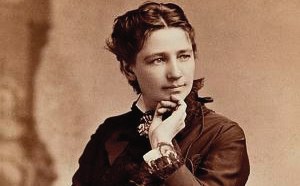
Victoria Woodhull PHOTO COURTESY OF WOMENSHISTORY.ORG
Because the U.S. Constitution does not guarantee women the same rights as men, the best way to rectify that omission is an amendment. But an “Equal Rights” drive for that purpose has stalled after more than 150 years of trying, although women and men are almost equal in number.
The push started when Victoria Claflin Woodhull, the first of more than 30 women to run for president, campaigned in 1872 as the Equal Rights Party candidate, as did Belva Ann Bennett, twice, more than 100 years later, in 1984 and 1988.
An Equal Rights Amendment (ERA) bill drafted by New Jersey-born Alice Stokes Paul and Massachusetts-born Crystal Eastman was introduced in Congress in 1923, or 102 years ago, by Sen. Charles Curtis and Rep. Daniel Anthony Jr., both of Kansas. It failed then but, in 1971, the House voted for it 354-24 and, a year later, the Senate, 84-8. But it required ratification by two-thirds of the states, for which Congress set a sevenyear deadline. Thirty states did so within a year but, by the deadline, only five more signed on. Congress extended the deadline by three years but no additional states joined in. Nevada did in 2017, Illinois in 2018 and Virginia 2020 – long after the deadline. Holdouts are mostly Southern states, including Florida, but that does not matter. For the amendment to become effective, Congress has to extend the deadline again.
The text of the proposed amendment reads, “Men and women shall have equal rights throughout the United States and every place subject to its jurisdiction. Congress shall have power to enforce this article by appropriate legislation.” But Illinois attorney Phyllis Schlafly and her STOP ERA supporters launched a campaign that is credited with blocking the ERA. They argued that it would lead to policies such as gender-neutral bathrooms, same-sex marriage and women in the military. (Even without the ERA, though, those rights were established by separate legislation.)
The backlash is gaining momentum now that conservatives control Congress, the Presidency and, evidently, the U.S. Supreme Court. Even the small gains outside of the ERA are being reversed in a “culture war” which started in states such as Florida and Texas and has gone national. They want to relegate women to the role of child-bearers and housewives.
Vice President James David Vance once ridiculed women who “spend 90 hours a week working in a cubicle … instead of starting a family and having children.” Katie Britt, an Alabama senator, delivered the Republican Party’s response to President Joe Biden’s 2024 State of the Union address, from her kitchen. The symbolism was not lost on some viewers but Britt was not alone in her message of where women belong. Some others have been more direct.
During a recent Turning Point USA Young Women’s Leadership Summit, The New York Times’ Emma Goldberg reported, wellness influencer and podcaster Alex Clark advised the 3,000 attendees: “Less Prozac, more protein. Less burnout, more babies. Less feminism, more femininity.”
Brett Cooper commented on her YouTube show about the brief space flight by Katy Perry, Gayle King and Laura Sanchez: “These women were completely dependent on men who built this spacecraft. Frankly, we all are, because men built civilization. They built the homes that we live in, they built the studio that I am recording in … the spaceships that all these rich celebrities are flying around in.” The difference between her and feminists, Cooper added, “is I choose to acknowledge that and celebrate it.” Reacting to Cooper’s remarks, The Guardian’s Anna Silman noted that the “bubbly, fast-talking 23year-old with silky espresso brown curls” has nearly one million YouTube subscribers and a Spotify audience that is about 60 percent female.
Silman reported that a “womanosphere” is being created as an “alternative rightwing media ecosystem directed at young female U.S. audiences – one of the few demographics that [have] until now, leaned substantially Democratic.” The womanosphere, she reported, includes Cooper’s channel, lifestyle magazines such as The Conservateur and Evie, Candace Owens’ Club Candace, Clark’s Maha (Make America Healthy Again), the Culture Apothecary talk show, Allie Beth Stuckey’s Relatable and Riley Gaines’ podcast Gaines for Girls.
“Draw the circle a bit wider and you get the ‘tradwives’ posting homemaking content on Instagram, the It Girls of Red Scare and ‘femcel’ influencers positioning themselves as the female answer to [neo-Nazi Andrew] Tate,” Silman wrote. (“Femcel” is apparently the female version of “incel” or involuntary celebate –an online community of young men embittered towards women for being unable to attract them sexually.)
“While the women behind these outlets all have different styles and tactics, they are mostly aligned in their desire to return to a gender-essentialist worldview: women as submissive homemakers, men as strong providers,” Silman wrote. They are not interested in “advancing policies like paid family leave or affordable childcare” but in a “return to an idealized, illusory past where being a wife and mother was viewed as a woman’s sole purpose.”
Women have favored Democratic presidential candidates for nearly half a century, including in the 2016 election, supporting Hillary Clinton by 13 points over Trump and giving Biden a 15-point advantage in 2020. However, although 2024 exit polls predicted 57 percent would vote for Kamala Harris, she got 8 percent fewer than Biden. African American women remained loyal, voting 92 percent for Harris, but that was not enough.
Joan Walsh wrote in The Nation that there had been “reason to hope that, even though a majority of white women voted for Trump in 2016 and 2020, they might finally break ranks with the candidate who was an adjudicated sex offender and who bragged about appointing Justices who overturned Roe v. Wade and vote for a woman who made abortion rights the centerpiece of her campaign.” But Walsh cited a Public Religion Research Institute (PRRI) report that eight in 10 European American evangelical women chose Trump. That was the “critical mass pushing white women over the top into majority territory for Trump,” PRRI director Robert Jones told Walsh.
Democratic election plans should take that reality into consideration but they are up against a movement that includes members who evidently take their cue from the Biblical story that Eve, the first woman, was created from Adam’s rib and so was inferior to him and also that she caused him to sin by enticing him to eat the forbidden fruit after being tempted by the devil, leading to their ejection from Heaven.
Another challenge for Democrats is the Internet, which, among other things, enables misogyny. Dayna Tortorici noted this in her New Yorker review of the book “Girl on Girl: How Pop Culture Turned a Generation of Women Against Themselves” by Sophie Gilbert, an Atlantic staff writer. Tortorici called attention to Vivian Gornick’s 1969 Rolling Stone feature on “women’s libbers” that explored ways by which men have dehumanized women sexually in media, movies and television shows.
The decline of feminism and the rise of misogyny, Gilbert wrote, has been due to the “pornification of pop culture” which has taught girls “that power for women was ‘sexual in nature,’ contingent on being attractive and able to cater to men’s contradictory wants. … Seventeen-year-olds were expected to be sexy virgins, girls with porn-star looks and purity rings, able to sell anything to any demographic.” The increasingly hardcore turn “trained a good amount of our popular culture … to see women as objects – as things to silence, restrain, fetishize, or brutalize.”
Or, as Gornick put it, channeling antiporn lawyer Catharine MacKinnon, “We are all living in the world that porn made.”
In light of all of this, there is a way to prove that the late Iowa-born physician Arthur E. Hertzler was correct when he wrote in his 1938 autobiography, “The Horse and Buggy Doctor,” that “Some vulgar person has said that when the wife is kept barefooted and pregnant there are no divorces. Bad as this sounds, it is so because it is so near the truth; but it does not fit into our growing notion of what constitutes civilized society.”
The republic’s 250th anniversary next year would be an ideal occasion to prove Hertzler right by passing the ERA.

Keep reading for free
You can unsubscribe from the newsletter at any time.




No Comment