











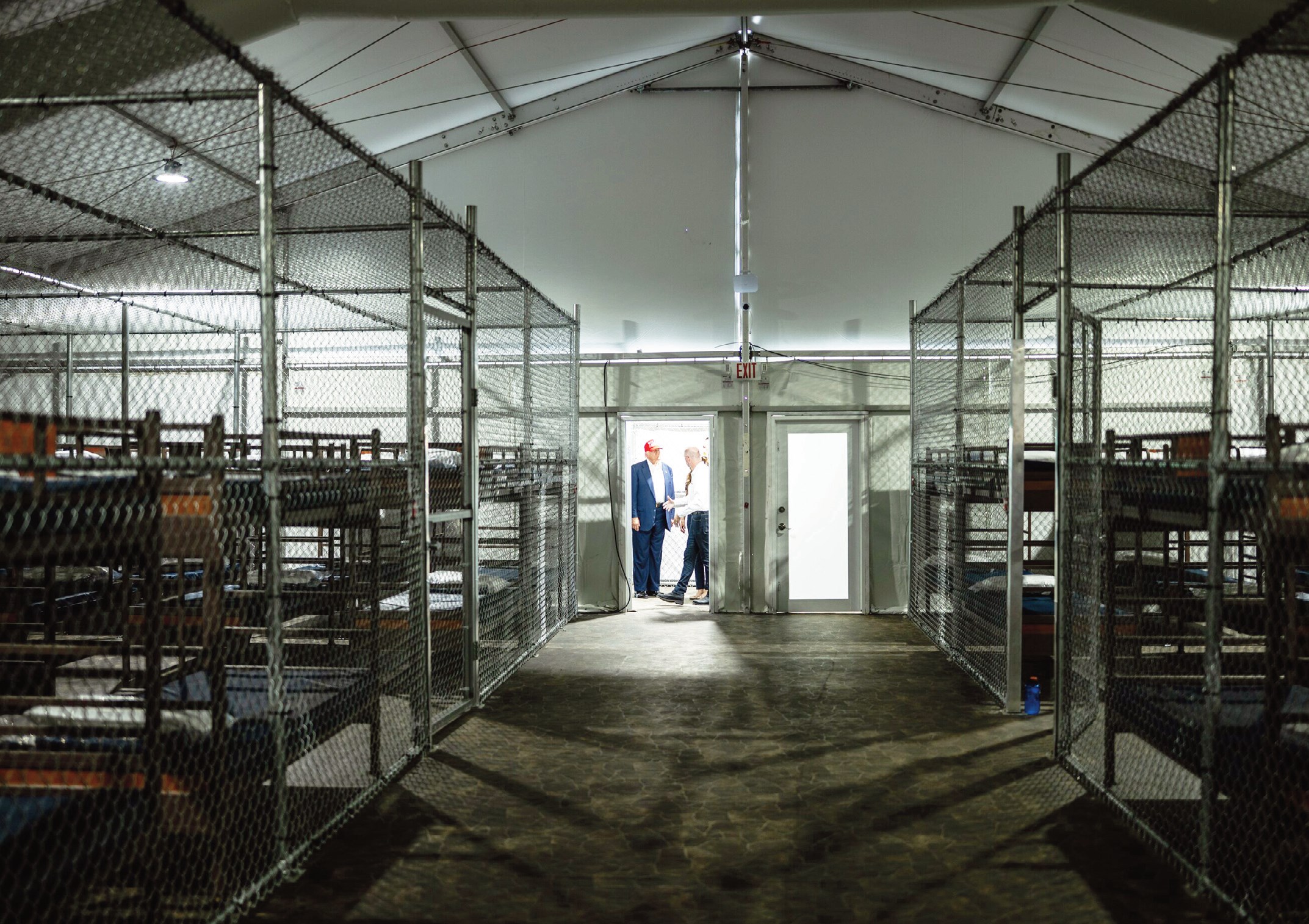
“ALLIGATOR ALCATRAZ”: Pushback seeks to stymie efforts to establish facts on the ground, with first arrivals expected imminently following Tuesday’s visits by Donald Trump, Ron DeSantis and Homeland Security Secretary Kristi Noem. PHOTO COURTESY OF WIKIPEDIA
By David L. Snelling
Miami – Florida’s conversion of an old Everglades airstrip into the makeshift immigration detention center dubbed “Alligator Alcatraz” is drawing strong opposition including a federal lawsuit.
Thousands of protesters including environmental advocates lined a stretch of a highway on Saturday, June 28 leading to the Dade-Collier Training and Transition Airport site 40 miles from Miami that would hold up to 3,000 detainees facing deportation.
The demonstration denounced the state’s plans which could affect Native American tribes and violate human rights for migrants.
The strongest opposition came from two environmental groups, Friends of the Everglades and Center for Biological Diversity, whose federal lawsuit cites the ecosystem and economy impacts.
The uproar stems from Florida’s stepped-up approach on President Donald Trump’s mass illegal immigration crackdown by using the site.
Florida Attorney General James Uthmeier, who is spearheading “Alligator Alcatraz,” said the detention center will have 5,000 beds by the first week of July. The first inmates were expected Wednesday.
Gov. Ron DeSantis also is pitching state-run immigration deportation flights at the isolated, 39-square mile airstrip, which has a 10,500-foot-long runway, to expedite the federal government crackdown including sending immigrants to countries other than their own.
The U.S. Supreme Court gave the Trump administration the option of deporting immigrants to their home countries or other nations, after overturning a lower court’s decision that temporarily halted the president’s policy.
DeSantis said the administration supports Florida’s proposal and will reimburse the state for building immigration detention centers in Florida.
The state is spending roughly $450 million for the Dade-Collier site and DeSantis has deployed about 100 Florida National Guard members to help secure it.
Florida seized the Everglades property from MiamiDade County through an emergency order despite pushback from Mayor Daniella Levine Cava and environmental advocates.
They said the building on sensitive wetlands could impact wildlife and the ecosystem which generates roughly $450 million in revenue annually.
“Due to the location of this parcel in a critical area, the conveyance of this parcel requires considerable review and due diligence,” Levine Cava said. “It is also imperative that we fully understand the scope and scale of the proposed use of the site and what will be developed, as the impacts to the Everglades ecosystem could be devastating.”
“We further requested the opportunity for an updated appraisal and a deeper financial analysis,” Levine Cava said, “to make sure we maximize the value of this public asset on behalf of Miami-Dade taxpayers – given the amount offered is $20 million whereas the most recent appraisal puts the total value of the site at at least $190 million.”
DeSantis said state officials are seeking to build similar detention centers in areas such as the Florida National Guard training center known as Camp Blanding, about 30 miles southwest of Jacksonville.
Everglades advocates wasted no time after Florida revealed its plan for Alligator Alcatraz.
Environmentalists filed a lawsuit in a Miami federal court to stop construction, arguing the facility violates the National Environmental Policy and Endangered Species acts, the Washington Examiner reported.
The Everglades, which is the largest remaining subtropical wilderness in the United States, is home to dozens of threatened or endangered species, including American flamingos, manatees, American crocodiles and wood storks.
Critics say officials are targeting local immigrants after Trump stripped them of their legal status which protected them from deportation.
Roughly 500,000 immigrants who came to live and work in America under the Biden-ear immigration policy for two years while seeking asylum were told to self-deport after the U.S. Supreme Court overturned a lower court’s ruling which granted them a temporary reprieve.
The immigrants are from Haiti, Cuba, Venezuela and Nicaragua, and most live in South Florida which has the largest populations from the four nations.
Trump’s immigration policy is spiraling into chaos for the South Florida community, where local elected officials and community leaders denounce the deportation of migrants who face imminent danger if they return to their home countries.
In Haiti’s case, escalating gang violence is gripping the Caribbean nation. Immigrants who face deportation are desperately searching for alternatives including asylum in France and other European nations.
At Miami’s crowded Krome Detention Center, reports of detainees living in deplorable conditions amid medical neglect have prompted congressional visits.
U.S. Reps. Fredrica Wilson and Carlos Giminez, both representing MiamiDade County, recently toured the facility to investigate.
So far this year, three deaths have been alleged at local detention centers.
On June 30, Isidro Perez, a 75-yearold Cuban man, reportedly died while in ICE custody at Krome Detention Center.
Last week, Johnny Noviello, a Canadian citizen, died while being detained at the Bureau of Prisons Federal Center in Miami.
The 49-year-old was found unresponsive and despite life-saving efforts including CPR and a defibrillator, was pronounced dead. Immigration officials reportedly are investigating the death.
In May, Marie Blaise, a Haitian American, died while being detained at a detention center in Pompano Beach after complaining about chest pains.
Two weeks following her death, immigration officials learned Blaise had legal status to be in the country including valid U.S. work authorization papers and a Social Security card.
Blaise’s death prompted a visit from Wilson and U.S. Rep. Sheila Cherfilus-McCormick, who discovered only one doctor on staff to treat medical emergencies for more than 500 immigrants.
Blaise had been given a pill to treat her chest pains instead of being transported to the hospital, the congresswomen reported.




No Comment