










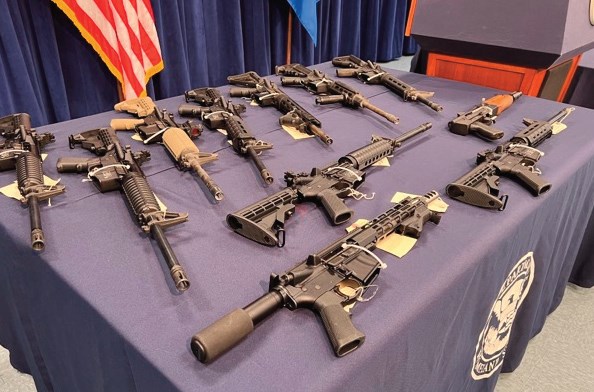
HSI announces crackdown on firearms, ammunition smuggling to Haiti, the Caribbean. PHOTO COURTESY OF ICE.GOV
By David L. Snelling
Miami – As the gang violence in Haiti continues to spiral into chaos, U.S. Rep. Sheila Cherfilus-McCormick is spreading an effort to stymie the illegal flow of firearms and ammunition from the United States to the embattled Caribbean nation.
Cherfilus-McCormick, the only Haitian American woman in Congress, filed a bill in April to address the root of the escalating gang violence. The bill is still pending.
But the Democrat from Broward County is stepping up the effort for faster action by leading a letter writing campaign with more than 32 of her colleagues calling on Secretary of State Marco Rubio and Secretary of Homeland Security Kristi Noem to immediately stop the pipeline of weapons between the two nations.
Cherfilus-McCormick said Haiti, which manufactures no guns or ammunition, has seen a staggering influx of illicit U.S.-origin weapons, primarily funneled through South Florida.
Between 2016 and 2023, 90 percent of illegal Caribbean-bound firearms shipments originated in Florida, including through the Miami River and Port Everglades.
These weapons are enabling gangs that now control over 90 percent of the capital, Port-au-Prince, to commit mass violence, displace over a million people, and kill thousands.
“The unabated flow of illicit arms to Haiti doesn’t just represent a threat to the safety of millions of Haitians on the island, that threatens U.S. national security as the instability created by gangs using U.S.-manufactured weapons drives outward migration” the lawmakers wrote.
As the lawmakers condemn the weapons flowing into Haiti, fueling the gang violence, Cheriflus-McCormick and her colleagues, including U.S. Rep. Fredrica Wilson (D-Miami), are suggesting several resolutions.
They include increasing CBP screening of outgoing cargo from high-risk ports in South Florida; partnering with ATF to trace weapons recovered in Haiti, mirroring efforts used in Mexico; closing shipping loopholes that allow anonymous packages under $2,500 in declared value; and coordinating an interagency strategy involving DOJ, Commerce, and Defense to disrupt arms trafficking.
U.S. Representatives Debbie Wasserman Schultz (D-Broward County), Darren Soto (D-Kissimmee), Kweisi Mfume (D-Maryland), Ritchie Torres (D-New York) and Maxine Waters (D-California) were among the 32 lawmakers who signed the letter to end gun trafficking to the Caribbean nation.
The urgent request for action comes three months after Cherfilus-McCormick co-sponsored a bill in hopes of addressing the problem but is currently undergoing review and consideration by both houses of Congress.
She said the proposed bill would require the Department of Defense to expand the mission of the Joint Interagency Task Force South to include efforts to stop illicit arms trafficking.
Citing a Government Accountability Office report, Cherfilus-McCormick said nearly 75 percent of firearms recovered and traced in the Caribbean could be linked to the United States.
Many of those weapons were initially sold through legal U.S. retail channels before being trafficked abroad.
The report suggested that the flow of gun trafficking is allowing gangs to control 85 percent of Haiti’s capital city of Port-au-Prince.
In April 2024, Haiti police seized two boxes that contained 12 assault rifles, 14 handguns and large quantities of ammunition.
According to the Tampa Bay Times, records revealed that a shipment of firearms travelled from a warehouse in Ft. Lauderdale, Florida to Cap-Haitian in northern Haiti in 2024.
Another container was shipped by the Florida-based shipping company Alliance International Shipping, which does not own vessels traveling to Haiti. The company only buys space on ships and sells it to clients.
The weapons allegedly ended up in the hands of two of Haiti’s most dangerous gangs— Viv Ansanm and Gran Grif — which the U.S. says is fueling the gang violence in Haiti.
The United States has officially designated the gangs as Foreign Terrorist Organizations, (FTOs) and Specially Designated Global Terrorists, (SDGTs), marking a significant shift in Washington’s efforts to combat violent instability in the Caribbean nation.
In a statement issued in May, Rubio said the designations are aimed at holding accountable those who fuel violence in Haiti and threaten the region’s security.
“The age of impunity for those supporting violence in Haiti is over,” Rubio declared.
Rubio said the armed coalitions are reportedly responsible for widespread killings, targeted attacks on Haitian citizens and security forces, and assaults against personnel of the Multinational Security Support (MSS) mission currently deployed in Haiti.


No Comment