








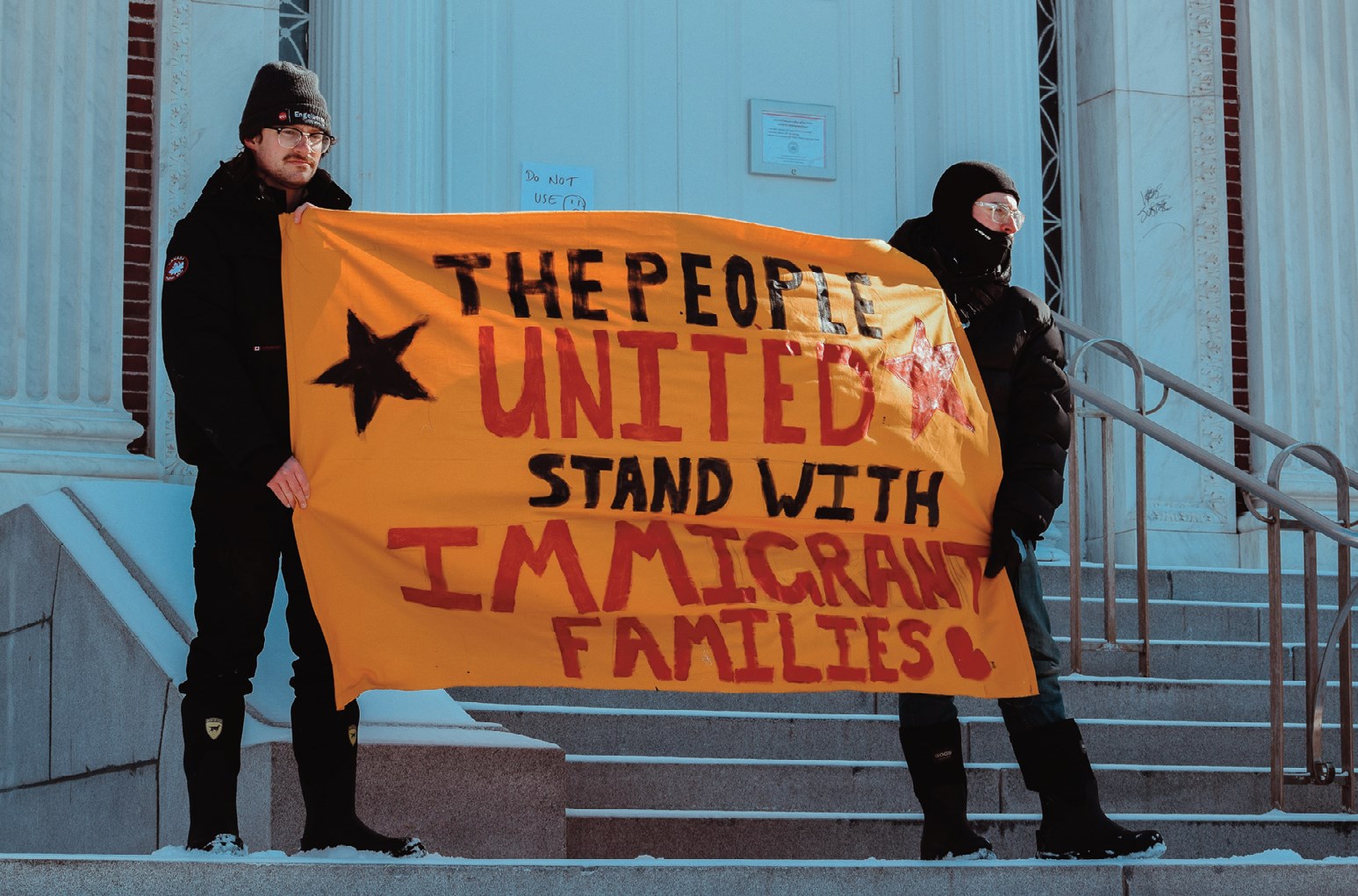
Pro-immigrant sign at a protest on Inauguration Day in Burlington, Vermont. PHOTO COURTESY OF WIKIPEDIA
By David L. Snelling
Miami – As the No Kings Day protests broke out throughout Florida and beyond this past weekend and millions of demonstrators denounced President Trump’s policies including ICE raids on illegal aliens, the state was dealing with a court loss to enforce its own illegal immigration enforcement law.
Days prior to the protests, a controversial Florida law which toughens penalties against undocumented immigrants entering the state and committing crimes was stymied again, this time by an appeals court in Atlanta.
Florida protesters praised the court’s decision, but Florida Gov. Ron DeSantis might have gone too far with his disturbing rhetoric to keep crowds under control during demonstrations that swept through the state.
DeSantis was trying to prevent unrest similar to that in Los Angeles that saw protesters attack ICE during a raid and caused a spat between Trump and California Gov. Gavin Newsom, who disagreed with the president sending the National Guard to quell violence.
But DeSantis and Brevard County Sheriff Wayne Ivey came under fire when they threatened deadly force if protests in Florida escalated to physical attacks on law enforcement and opposing voices.
Last week, DeSantis told reporters drivers have the right to “hit them with their cars” if they are threatened.
Ivey echoed similar sentiments.
“If you throw a brick, a firebomb, or point a gun at one of our deputies, we will be notifying your family where to collect your remains, because we will kill you, graveyard dead,” Ivey said during a press conference, referring to protesters expected to gather over the weekend.
Some arrests were made around the country, but a protest in Salt Lake City Utah turned deadly when someone fired shots into a crowd, killing one man. Police took the suspect into custody.
Protesters flooded the streets in South Florida during the same time Trump threw a military parade in Washington D.C. to celebrate the U.S. Army’s 250 anniversary which coincided with his 79th birthday celebration.
Demonstrators also attempted to march to Trump’s Mar-a Lago estate in Palm Beach County, but authorities prevented them from crossing a bridge that connects to the Town of Palm Beach.
They held placards calling for his impeachment over his dictatorship- like policies including threatening to deport over 500,000 migrants after stripping them of their legal status, among other Trump’s policies they denounced.
Florida bolstered Trump’s massive immigration crackdown by enacting a more controversial anti-immigration law which has drawn legal challenges since DeSantis signed it into law in February.
Florida law included criminalizing undocumented immigrants who enter the state without the knowledge of immigration officials and imposing the death penalty for those convicted of a capital crime such as murder and sexual abuse of children.
But an appeals court upheld a lower court’s decision which temporarily halted Florida’s immigration law, delivering another blow to DeSantis and Florida Attorney General James Uthmeier.
Uthmeier filed the appeal in an attempt to overturn U.S. District Judge Kathleen Williams’ decision to block Florida’s law last month after she agreed with the American Civil Liberties Union (ACLU), who filed the injunction.
The ACLU called it unconstitutional and dangerous.
Despite Williams’ ruling, the state proceeded with the immigration enforcement law and the federal judge threatened to hold him in contempt of court for violating her order.
Uthmeier decided to take the state’s case to the U.S. Court of Appeals for the 11th Circuit Court in Atlanta which agreed with Williams’ decision to stop Florida from criminalizing undocumented immigrants.
The ACLU said the appeals court made the right decision because the law is unconstitutional and overbearing.
“The court also cited Attorney General Uthmeier’s troubling letter that had encouraged law enforcement officers to violate the district court’s injunction, which was recently the subject of a hearing in district court to consider possible contempt-of-court findings and sanctions,” the ACLU said in a press release.
Bacardi Jackson, executive director of the ACLU of Florida, said the Florida measure was out of line from the beginning.
“This ruling is not just a legal victory, it’s a resounding rejection of cruelty masquerading as policy,” Jackson said. “Florida lawmakers tried to use fear as law and racial profiling as governance. SB-4 was a flagrant abuse of power designed to punish immigrants and divide our communities. But the Constitution does not bend to political theater.”
Some critics said Florida’s immigration enforcement law is overbearing, especially when Florida deputized local law enforcement agencies including the Florida Highway Patrol to be trained by ICE, giving them power to enforce state and federal immigration laws.
That includes questioning and arresting those suspected of being in Florida illegally.
However, some Florida law enforcement agencies initially refused to take part in enforcing immigration laws but changed their tones after DeSantis and Uthemeier threatened suspensions, termination and fines if they didn’t comply.
Broward County Sheriff Gregory Tony and Utmeier initially exchanged heated letters over enforcing U.S. immigration laws by arresting illegal aliens responsible for serious crimes.
Tony told Broward County commissioners during a budget workshop that his department is not focusing on immigration, when he proposed his $1.5 billion budget for the next fiscal year.
Utmeier sent Tony a letter and threatened to remove him from his position if he didn’t enforce immigration laws within his jurisdiction.
Tony changed course.
“It is BSO’s priority to address criminal activity within our community, including crimes committed by unauthorized aliens, and to work with our federal partners in this endeavor,” Tony wrote.
In May, DeSantis announced that federal and state officials arrested 1,100 illegal immigrants in Florida who had criminal backgrounds in a one-week period during Operation Tidal Wave.

No Comment