







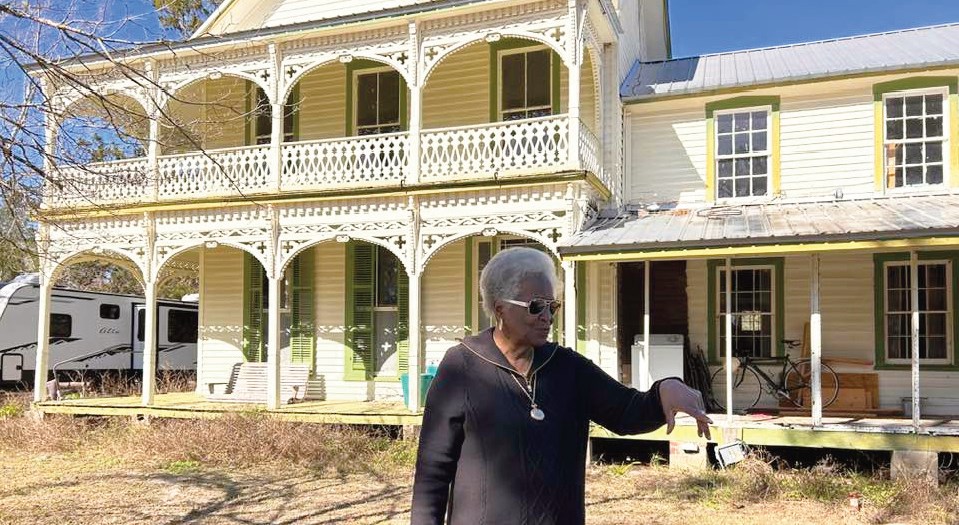
LIZZIE JENKINS: The founder and president of the Real Rosewood Foundation stands in front of the home of John and Mary Wright. The white couple hid Jenkins’ aunt, Mahula Gussie Brown Carrier, and others in their home during the Rosewood Massacre. PHOTO COURTESY OF THE REAL ROSEWOOD FOUNDATION
By David L. Snelling
Miami – A white woman’s alleged lie that a Black man attacked and sexually assaulted her in a rural Florida town 102 years ago sparked one of the darkest chapters in American history.
White men, including Klu Klux Klan members who were in a nearby town for a rally, brutally attacked Blacks in the Rosewood Massacre, reportedly killing 27 people and burning down the predominantly African American town.
The racially motivated attack has been chronicled in movies, novels and newspaper articles over the years, and generations of African Americans have visited the site along State Road 24, a few miles northeast of Cedar Key in Levy County.
But the Real Rosewood Foundation says significant events tied to the massacre have been omitted, prompting a fundraising effort to build a Rosewood Massacre Museum.
The proposal is in the planning stages with initial renderings completed on a 30-acre site in Archer, Florida.
The foundation’s president, Lizzie Jenkins, whose aunt Mahula Gussie Brown Carrier was a Rosewood Massacre survivor, was the inspiration for the museum on what would’ve been her 131th birthday.
Jenkins told the South Florida Times that the foundation is seeking $5-$8 million to build the museum on property her family has owned for decades.
Jenkins, 86, said her aunt was ganged raped during the Rosewood massacre, but managed to escape. She and others sought refuge in the woods and swamps and found their way to the home of a white couple, John and Mary Wright, who hid them in their home until the carnage was over.
Jenkins said the museum will be a painful reminder, but the story must be told about the massacre, and the innocence of the African American man accused of assault.
Some white people later discovered that the accuser, Fannie Coleman Taylor, a married white homemaker of Sumner, Florida, might have lied. They suspected her husband was her attacker.
Jenkins said she initially proposed building the museum in Levy County where the massacre occurred, but officials rejected the location.
“They don’t want any part of the lynching of Blacks in the town,” she said.
The Archer museum site is 37 miles from Levy County.
Jenkins said Archer officials declined to financially support the museum, but the foundation is working with the African American Studies department at the University of Florida to secure grants and other funding resources.
“We’re reaching out to other people including Tyler Perry and Oprah Winfrey,” Jenkins said. “The department has the connection and power to do that.”
Jenkins said the abandoned John and Mary Wright house was donated to the foundation by the new property owner who wanted it moved off the lot.
Jenkins said she had to decline the offer because it cost more than $600,000 to move it to Archer.
“We didn’t have the money,” she said. “It’s still on his property.”
Jenkins endured attacks and insults at the hands of white people long after the massacre, she said.
She said she was 20 years old in 1960 when she and other junior members of the NAACP joined the Civil Rights Movement and staged a sit-in at a local market protesting segregation.
A KKK member kicked her in the month, Jenkins said. “It’s horrible, it was so painful with steel toe boots.”
Building the museum will be another accomplishment in recognizing the massacre and survivors.
Jenkins said in the early 2000s, she spearheaded a campaign for the Rosewood Massacre historical marker in Levy County.
Then-Florida Gov. Jeb Bush received a pipeline of letters from her and others underscoring the significance of Rosewood and preserving its history, she said.
Bush dedicated the marker on May 4, 2004.
“It wasn’t easy,” Jenkins said. ” I made sure Florida had a historical maker and I worked diligently with the Jeb Bush administration to make sure it awarded a historical maker.”
The marker has been vandalized over the years, however, and money was spent to fix it.
Jenkins said she hopes the Rosewood Massacre Museum serves as the catalyst for social outlook.
“We are going to preserve history, preserve family history and preserve Rosewood history,” she said. “We want to reach people and tell them all about history made to make America a better and stronger place. The younger generation can learn about their history.”
Dr. Marvin Dunn, Florida International University psychology professor emeritus, historian and founder of the Miami Center of Racial Service, offers tours of African American historical sites in Florida including Rosewood.
Dunn said he purchased land in Rosewood to preserve it as an historical landmark.
He said he knows Jenkins and offered his help with raising money and building the museum.
“I wish them well,” Dunn told the South Florida Times. “If I can help in any way I would.”





No Comment