







Kamehameha Schools PHOTO COURTESY OF KAMEHAMEHA SCHOOLS
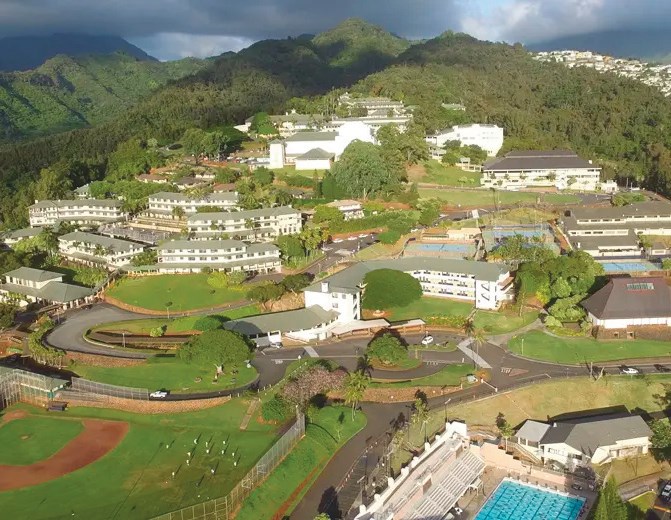
Honolulu (AP) — After water polo practice at her school atop a hill overlooking Honolulu Harbor, Kapua Ong marvels at the sunset.
“I do feel proud of myself for getting in because not everyone gets accepted,” said Kapua, 14, a freshman at Kamehameha Schools, a competitive private school with affordable tuition that gives preference to Native Hawaiians. “I’m just, like, grateful for being able to have those opportunities."
Kapua was just a baby when her parents set the stage for her acceptance at the school by adding details of her Native Hawaiian ancestry to a genealogy database. As an incoming seventh grader, she also took an admissions test and highlighted her kung fu skills and fluency in Hawaiian language.
Kamehameha Schools gives admissions preference to the Indigenous people of Hawaii, with a caveat: “to the extent permitted by law."
A campaign is underway to test the policy’s legality and stop Kamehameha from favoring Hawaiians, part of a movement to expand the legal definition of racial discrimination in education. Conservative activists have been emboldened by a Supreme Court ruling against affirmative action in college admissions and by the Trump administration’s war against diversity, equity and inclusion. Now, they’re targeting scholarships, academic programs and admissions policies tied directly or indirectly to race.
Students for Fair Admissions, led by Edward Blum, a leading opponent of affirmative action, set up a website this month vowing to challenge Kamehameha’s admissions policy in court. "It is essentially impossible for a nonNative Hawaiian student to be admitted to Kamehameha,” the site says.
Alumni, parents and local leaders are urging the private school system with an endowment valued at more than $15 billion — larger than most universities — to fight to defend the policy.
“I’m hoping they hire a good lawyer, build a good case,” said Andria Tupola, a 1998 graduate and a member of the Honolulu City Council. She says the school helped her build a stronger connection to Hawaiian culture.
Attending Kamehameha can also be life-changing. The Native Hawaiian community struggles with higher rates of poverty and incarceration, so Hawaiian children may have educational disadvantages. Admission to Kamehameha offers a chance for quality private school education — with boundless opportunities, first-class facilities and Hawaiian cultural values.
Along with a breathtaking ocean view, the sprawling Honolulu campus boasts top amenities — an Olympicsized pool, buffet lunches, athlete laundry service and grounds adorned with native plants. An annual, elaborate Hawaiian song contest between high school classes is broadcast on local TV.
A Hawaiian princess’s will
Kamehameha Schools was founded by the will of Bernice Pauahi Bishop, the great-granddaughter of King Kamehameha I. When she died in 1884, her will directed the establishment of schools that give preference to Native Hawaiians. The endowment also supports scholarships to other private schools, plus community activities.
Last year, more than 5,400 students enrolled across three Kamehameha campuses on Oahu, Maui and the Big Island.
Each year, the number of applications exceeds the number of spaces by as much as 17 to 1, depending on the campus and grade, the Kamehameha website says.
There’s an understanding among Hawaii residents that only students with Hawaiian blood will be admitted. Many see the policy as a way to remedy disparities stemming from U.S. colonization and the 1893 overthrow of the Hawaiian Kingdom by a group of American businessmen.
Sterling Wong, a Kamehameha spokesperson, declined to say how many non-Hawaiian students have been admitted.
Kalani Rosell was the first non-Hawaiian to graduate from Kamehameha Schools Maui in 2007. His acceptance drew sharp criticism from Hawaiians. The school said he had been selected after a list of qualified Hawaiian students had been exhausted.
More than 15,000 people protested after a 2005 ruling by a panel of the 9th U.S. Circuit Court of Appeals struck down the policy of restricting admission to Hawaiians, ruling it violated federal civil rights law. Kamehameha sought a rehearing.
The following year, the court upheld the policy. Kamehameha later settled with the family of the white student who brought the case when he was denied admission.
“We anticipated that our nearly 140year-old admissions policy, providing preference to Native Hawaiian children, would again be challenged," Kamehameha trustees said in a statement. “We are confident that our policy aligns with established law.”
‘Heavy hitter’ takes on the Hawaiian schools
When Kekoa Kealoha, who graduated in 2003, heard about the campaign against the school, he was shocked to hear it was led by "somebody who was, like, a real heavy hitter."
Students for Fair Admissions sued Harvard and the University of North Carolina in cases that led to the landmark 2023 Supreme Court decision barring colleges from considering race in admissions decisions.
Blum, a former stockbroker, has since expanded his opposition to racial preferences throughout education, fueled by President Donald Trump’s fight against DEI.
Blum’s group probably will argue the Kamehameha policy is unlikely to survive the strongest form of constitutional review because it has an absolute race-based requirement for admissions, said John Tehranian, a professor at Southwestern Law School in Los Angeles.
Kamehameha could counter that its policy is not race-based, but a classification based on political status, drawing on cases that allow government programs for Native Americans, he said.
When Blum launched his campaign against Kamehameha, people started calling Brenton Awa, a Hawaiian Republican state senator.
Awa didn’t get into Kamehameha and graduated from a public school, but he called Blum anyway. When Blum didn’t call back, Awa and another Republican flew to the East Coast to find him.
“If anybody had a chance at discussion, it would be us,” Awa said.


No Comment