








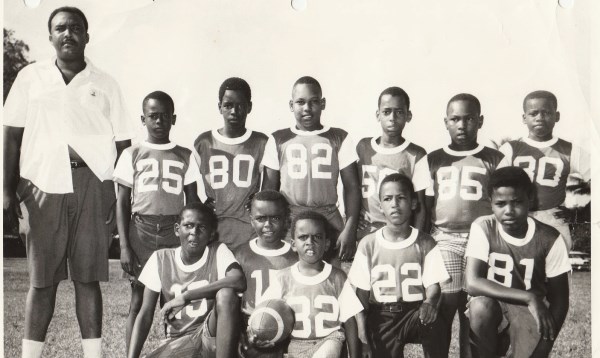
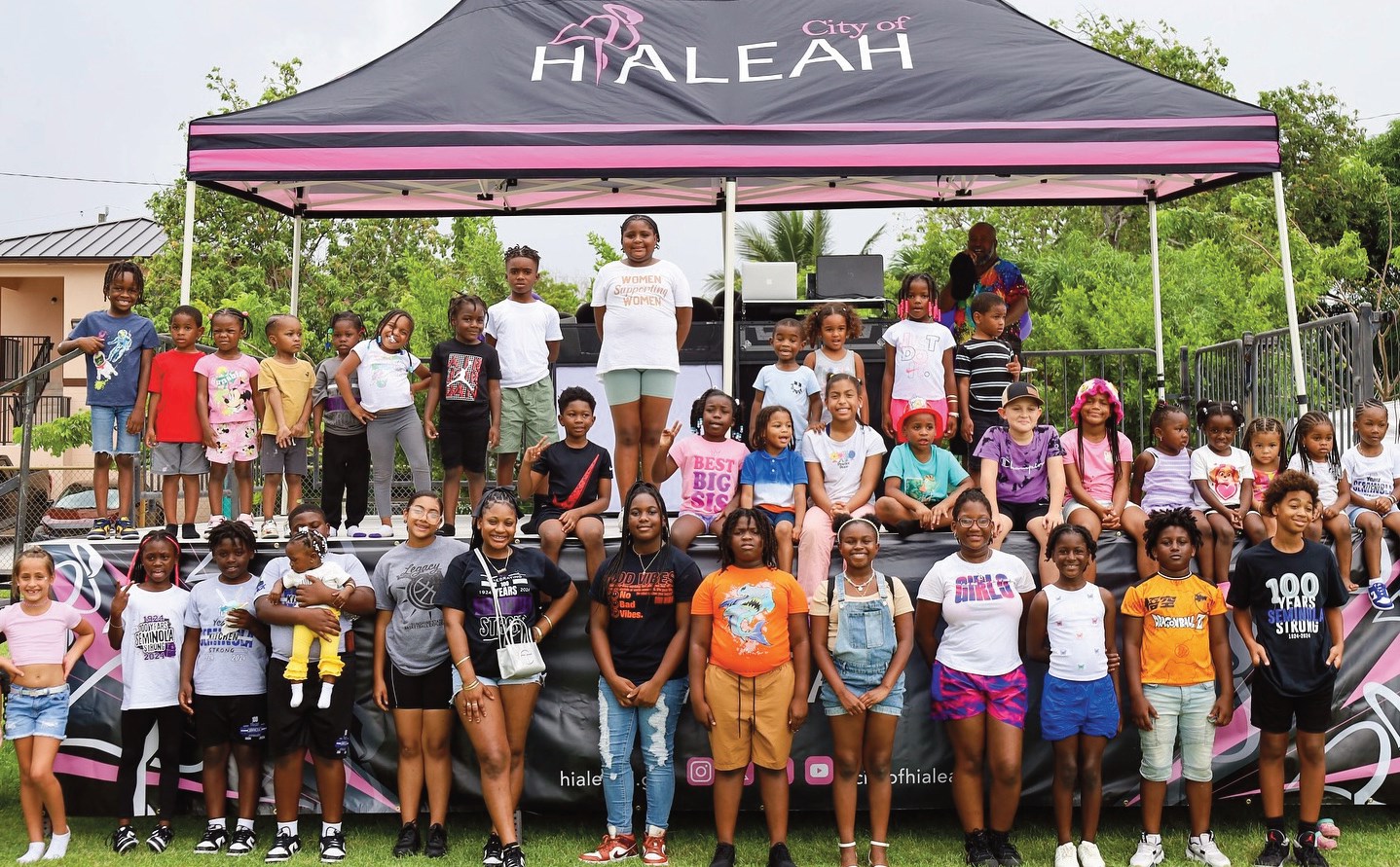
Johnny L. Cotson, community activist and park director, with kids. PHOTO COURTESY OF REGINALD GAY
By David L Snelling
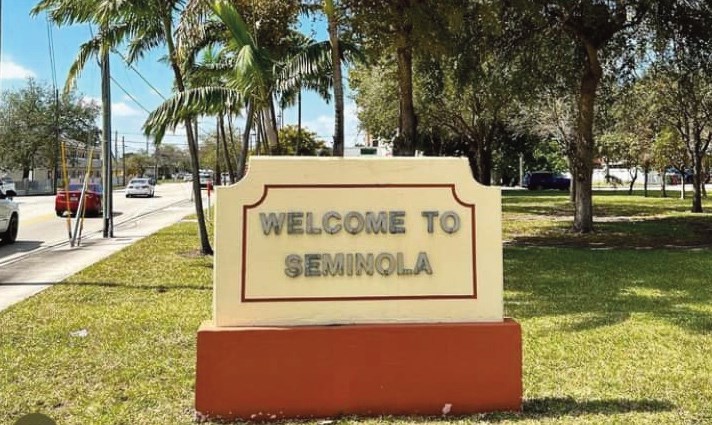
Hialeah, Fla. – One of the oldest Black neighborhoods in Miami-Dade County, Seminola’s African American population has shrunk over the years as the Hialeah community continues to draw a massive influx of Hispanics.
But some Blacks feel they are being pushed out of the Hispanic populous city and those who remained campaigned for Hialeah officials to preserve the neighborhood and its history amid a rash of new developments of apartment complexes, industrial and commercial buildings.
But their pleas fell on deaf ears.
According to Reginald Gay, who has been living in the community for 68 years, a pocket park, community swimming pool and other buildings named after original Black Seminola residents all were torn down to make way for the new developments.
All that remains are three historically black churches along with several stores and Cotson Park, which was named after activist Johnny L. Coston.
But Seminola residents feel they, too, may be replaced with new developments in the future.
As Hialeah celebrates its Centennial on September 10, 2025, Black Seminola residents feel left out as the community is excluded from festivities commemorating the city’s 100th year.
Seminola was discovered in 1924, a year before Hialeah incorporated, and 94 percent of the city’s residents are Hispanics with a population of 221,300, according to the 2020 U.S. Census report.
Hialeah is the second largest city in Miami-Dade.
Seminola borders West 25th and 26 streets, West 8th Avenue, the Hialeah Expressway and Red Road.
Gay said residents are left in the dark about Hialeah’s plans for the community.
“One day, we see something being torn down and the next we see construction of buildings,” Gay told the South Florida Times. “Everything they do to Seminola they do it behind our backs.”
Gay, a Hialeah school crossing guard, said the city demolished a community swimming pool, which was part of the neighborhood for more than 40 years, and replaced it with a 60-unit apartment complex.
He said it was named after one of his relatives, Rudolph Reed, who was among the oldest Black Seminola residents, who died in World War II.
Gay said city officials also tore down a historic two-story Black-owned store, which rented rooms to tenants, a small shopping center and a nightclub called Cadillac frequented by African Americans.
“They took it away,” Gay said.
The neighborhood was developed by Black laborers who built the Hialeah Race Track and originally was a 100 percent African American community.
But the population declined over the years; at one point 50 percent in the 1970s as residents moved to other areas and cities and the influx of Cuban exiles in Hialeah.
Today, Seminola is 25.3 percent Black and 73.2 Hispanic.
In the 1990s and 2000s, some Black Seminola residents could no longer afford the property taxes as values soared over the years and either moved or their homes were in foreclosure.
Gay, who was born and raised in Seminola, said the Hispanic population currently outnumbers Blacks in Seminola, roughly 800 to 250.
He said he and other Black Seminola residents hope the city preserves what’s left of the Black historic neighborhood.
That includes Cotson Park named after Coston who was the park’s director for years.
Gay depicted Cotson as a no-nonsense and tough minded person but despite his demeanor, kids in Seminola looked up to him.
Coston died in 1980 at the age of 46.
“All the Black kids played sports under Coston,” Gay said. “Every kid who grew up in Seminola knew Cotson. Nobody played with that guy or he would show the kids his belt.”
Roderick Mason, who was also born in Seminola and now lives in Atlanta, Georgia, said there have been offers from real estate developers to sell his parents’ home but he declined.
Mason, 47, who rents out the house to relatives, said he fears developers want the property to tear it down and build residential units on the 1,837 square foot property.
He said the value of the home is worth $430,000 as of 2024.
“I don’t want to sell because it was the house my parents bought and I lived in with my wife and kids,” said Mason, who moved to Atlanta for a better paying job. “That property is history and I want to keep that history around.”
Hialeah city officials didn’t respond to an interview request.
On social media, Hialeah posted that the city is highlighting the rich history of Seminola’s Centennial celebration in 2024.
“We honor the Seminola community’s deep pride in their roots and appreciate their invaluable contributions to the development of the City of Hialeah,” the statement said. “For generations, Seminola has been a gathering place where families have grown, traditions have been honored, and stories have been shared.”

No Comment