







By David L. Snelling
Miami – Repealing a 71 year-old law, the IRS is now allowing churches to endorse political candidates without losing their tax-exempt status after a federal judge forced the government agency to do so.
The court’s ruling ends decades of clamor that placed houses of worship in a difficult position during campaign season.
Previously, the federal government threatened to revoke churches’ tax exempt status for allowing political candidates to speak during worship services, even though they never endorsed the candidates.
According to the United Press International, the IRS was forced to terminate the Johnson Amendment after a coalition of churches in Texas filed a federal lawsuit in 2024.
The churches argued that the Johnson Amendment violates First Amendment rights to freedom of speech and free exercise of religion.
Before he became president, in 1954, then-U.S Senator Lyndon B. Johnson sponsored the Johnson Amendment which banned any political campaign activity by candidates and charities in churches or lose their tax-exempt status.
A judge sided with the churches and ordered the government agency to stop enforcing the Johnson Amendment which Congress passed over 70 years ago.
President Donald Trump told reporters last week that he praised the court’s decision to eliminate the Johnson Amendment.
“I love the fact that churches can endorse a political candidate,” he said. “We have a lot of respect for the people that lead the church.”
The decision has yielded mixed reactions from lawmakers and faith leaders.
Critics say the churches can use the pulpit for a political platform while proponents say they have the right to overtly support candidates they support. Antagonists also suggested it can open the door to extreme views on racism, homophobic and attacks on political parties.
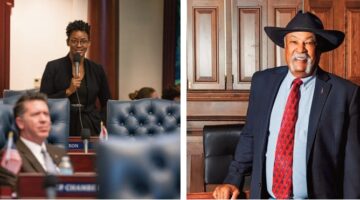
State Senator Shervin Jones (D-West Park) says he strongly disagrees with allowing churches to endorse political candidates while keeping their tax-exempt status
“This is not just about politics in the pulpit, it’s about the rise of Christian nationalism being legitimized by our institutions,” Jones told the South Florida Times. ” Let’s be clear: this ideology isn’t rooted in love, justice, or equality. It’s tied to racism, misogyny, homophobia, xenophobia and a dangerous rewrite of what God’s love actually means.”
Jones said churches should be places of refuge and truth, and not political tools used to divide and discriminate.
“This move risks turning some pulpits into platforms of extremism, cloaked in spirituality, and backed by taxpayer dollars,” he said. “That’s not just unconstitutional…. it’s morally reckless.”
Civil rights leader and radio talk show host Rev. Al Sharpton said allowing political endorsements in churches might create a double-edged sword.
“We cannot have a system in which right-wing congregations may endorse political candidates and others of a different political persuasion remain under scrutiny and lead to a situation that is not beneficial to all,” Sharpton said in a statement.
Sharpton, who is president of the National Action Network, a civil rights organization, said the group will meet with Black pastors to explore the pros and cons of the decision.
Rev. Richard Dunn, senior pastor of Faith Community Baptist Church in Miami and a former city of Miami commissioner, agreed with the decision but warned it could lead to a self-serving political agenda for the GOP in 2026.
Next year are the crucial midterm elections when Democrats are seeking a turning point after the GOP red wave swept the 2024 Presidential election.
“My immediate reaction was it was too little, too late,” Dunn told the South Florida Times. “But I think it’s a good thing but let’s not be deceived… we must realize it opens the door for white conservative churches to support Trump and his Make America Great Again (MAGA) doctrine. The churches did it before but they were never investigated over the Johnson Amendment.”
Dunn, however, said the decision lifts a burden for churches and even for him as well.
Dunn, who won a commission seat in 2010, said the Johnson Amendment prohibited him from announcing he was running for reelection from the pulpit fearing he would lose the church’s tax-exempt status.
He lost to Keon Hardemon in a run-off election in 2013.
“It’s an opportunity for candidates of people’s preferred choices to share their platforms in church,” Dunn said. “Black churches could not be vocal from the pulpit for that reason.”
Miami’s Friendship Missionary Baptist Church was caught in a religion-political storm in 2004.
The IRS threatened to revoke the church’s tax-exempt status when Pastor Gaston Smith invited then Democratic Presidential candidate John Kerry to a Sunday worship service.
According to the Christian Post, the Rev. Jesse Jackson and the Rev. Al Sharpton were also in attendance endorsing Kerry in his bid to defeat Republican President George W. Bush.
The Americans United for Separation of Church and State (AUSCS) sent a letter to the IRS asking to investigate whether Friendship allegedly violated its taxexempt status by having Gaston campaigning for Kerry during Sunday service.
The organization argued the service was a political rally in which the church endorsed a political candidate, and the pastor led a chant about voting for Kerry.
Kerry’s appearance at the church drew national headline news when Gaston and his church became a lightning rod for criticism by the AUSCS and the Members of The Interfaith Alliance, which in 2004 represented 150,000 members from more than 75 faith traditions including Christianity.
After an investigation, the federal government ruled that Friendship didn’t violate the Johnson Amendment and kept its tax-exempt status.
Smith couldn’t be reached for comment.
Dunn, who was familiar with Friendship’s ordeal, said the federal government threatened Gaston with a lawsuit over the Kerry brouhaha along with taking away the church’s tax-exempt status.
“That took him through hell,” Dunn said.
About 8 in 10 U.S. adults believe churches and other houses of worship should not come out in favor of one political candidate over another during elections, according to a 2022 Pew Research Center study.
White evangelicals and Black protestants were a little more divided on the issue, with about one-third in each group favoring political endorsements.
But in every other religious group surveyed, there was a strong consensus against political involvement by houses of worship.

No Comment