








Photo courtesy of latimes.com
By David L. Snelling
MIAMI – Haitians with Temporary Protection Status (TPS) were granted a temporary reprieve as a federal court order extended their work permits until July 24, 2026.
The order comes nearly a month after the United States Supreme Court gave the President Donald Trump administration the green light to end TPS for Haitians and Syrians living and working in the U.S.
But their future still hangs in the balance following the ruling, as the U.S. Department of Homeland Security has announced it is set to launch another round of Trump’s deportation operation.
Haitians can self deport or be forced to return to the embattled Caribbean nation which is gripped by the escalating gang violence.
Protesters around the U.S. said the U.S. economy would be impacted if Haitians’ work permits are not extended after July 24 and sent back to their homeland.
According to a study conducted by NBC News, Haitians with TPS make up a significant share of the U.S. healthcare workforce, especially in long-term care, home health, and nursing roles.
Across the U.S., about 330,000–350,000 Haitian TPS holders are in the country, and roughly one-third work in healthcare.
In Florida, where about 158,000 Haitians have TPS, an estimated 25 percent work in healthcare, roughly 39,500 people.
South Florida is home to one of the biggest Haitian populations in the nation.
In New York, over 112,000 Haitians work in healthcare, and nationally, about 13,000 Haitian nursing assistants on TPS care 65,000 patients daily.
Many serve as home health aides, certified nursing assistants (CNAs), licensed practical nurses (LPNs), and caregivers in nursing homes, assisted living facilities, and memory care units.
They often work two to three jobs to support themselves and families, with many also contributing to the economy through taxes and community involvement.
Lawmakers from both parties said the nation is bracing for a healthcare crisis if TPS for Haitians is not preserved.
“Of the 350,000+ lawful Haitian TPS holders, roughly 1/3 work in our healthcare system. Immediately shutting off TPS will create a crisis in our hospitals, nursing homes, and in the (intellectual disabilities) community,” U.S. Rep. Mike Lawler, R-N.Y., wrote on X.
Said U.S. Rep. Ayanna Pressley, D-Mass: “Seniors will lose their caregivers when we already have a caregiving crisis, and seniors will lose their ability to age in community with much needed assistance.”
North Miami state Rep. Dotie Joseph, Haitian-born Democrat who is running for governor, told WPLG’s Glenna Milberg on “This Week in South Florida” that targeting an immigrant-heavy workforce amid steep labor shortages in tourism, agriculture and healthcare “is insane.”
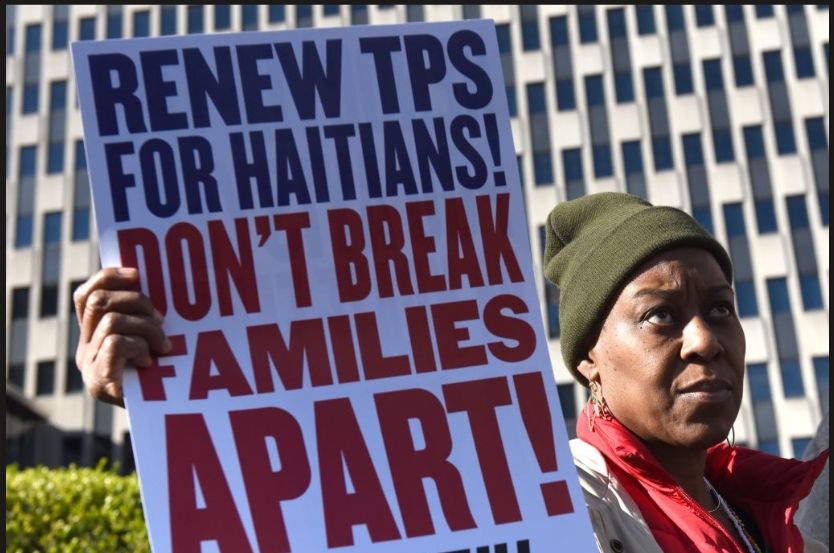
Protests erupted nationwide, as hundreds of thousands of political and faith leaders, labor unions and humanitarian advocates urged the U.S. Senate to pass legislation in a last-ditch effort to protect Haitians from deportation.
In April, U.S. Congress passed legislation to preserve TPS for Haitians in which Republicans broke ranks to side with Democrats, dividing the GOP and impeding Trump’s effort to remove the Caribbean nationals.
Now, Haitians are waiting for a Senate vote, which no timetable was offered as the nation is preparing for the upcoming midterm elections.
The court’s TPS decision is part of a broader plan by Trump to launch one of the largest immigration deportation operations in U.S. history but the harsh conditions in Haiti, Syria and now earthquake-scattered Venezuela have some Republicans calling for an extension.
U.S. Rep. Carlos A. Gimenez (R-Miami), a reliable Trump ally who has backed the president’s immigration agenda, is singing a different tune now with Haitians, Syrians and Venezuelans under TPS.
Gimenez told CBS News’s Face the Nation that deporting the immigrants with TPS is a huge mistake and arguing that the program exists precisely for anarchy engulfing Haiti and Syria.
Gimenez is also calling for TPS extension for Venezuelans following two back-to-back power earthquakes on June 24, 2026, as the death toll has reached 4,490.
“TPS was created for these types of crises and that’s why I am demanding the administration to reinstate and extend TPS,” he said.
He did, however, argue that TPS shouldn’t function as an indefinite substitute for adjusting one’s immigration status, adding that the immigrants it protects “could have applied for a visa” or lawful permanent residency.
On social media, Joseph said 1.3 million TPS holders and their families are at risk of losing protections following the Supreme Court’s decision.
“TPS holders have built their lives in the United States. They are raising families, working in hospitals, hotels, restaurants, farms, and businesses, and contributing billions of dollars to the economy every year,” she said.
Last month, the highest court in the nation ruled in favor of the Trump administration to end TPS for roughly 350,000 Haitians and 6,000 Syrians nationwide.
TPS was granted to Haitians who fled the Caribbean nation amid the escalating gang violence and political turmoil, and the aftermath of the 2010 earthquake.
The death toll from the gang violence has reached about 3,000 in Haiti and cut off medical supplies and humanitarian aid, according to a United Nations report.
Thousands of Haitians were displaced after their homes were seized or destroyed by gangs, forcing them to seek refuge in sordid shelters, lacking food and water.
Some reports suggest rape victims among women and teenage girls.
Some Haitians with TPS since the 2010 earthquake have built new lives in the U.S. but now are in peril, as refugees are at risk of losing their homes and separated from family members if they are deported.
According to Pew Research Center, about 30 percent of Haitians living in the U.S. on temporary visas are reportedly homeowners after the program has been extended for years by former U.S. Presidents Barack Obama and Joe Biden.
It’s quite an accomplishment amid an affordable housing shortage, as half of American-born citizens say they have difficulties buying a home.
About 28 percent of Haitian migrants in the U.S. were homeowners in 2023, which is roughly 5 percent higher than CMS’s pre-Biden administration 2017 rate.
Approximately 27.1 percent of Zoomers (people born between 1997 and 2012) became homeowners in 2025.
In addition, 38.3 percent of Zoomers, 42.5 percent of Gen Xers (born between 1965 and 1980), and 44.4 percent of Boomers (born between 1946 and 1964) reportedly bought a home between 2022 and 2024.
Roughly 25 percent of those populations said it’s difficult to purchase a home on their incomes and the skyrocketing housing costs in the U.S.
U.S. Rep. Yvette Clarke (D-New York) was among the Black leaders rallying to the defense of Haitians with TPS, saying deportation would take away their new lives in the U.S.
“I join leaders and advocates from across Brooklyn in righteous opposition to the vicious SCOTUS ruling to prematurely end TPS for Haiti,” she said on social media. “TPS holders are our neighbors, friends, and loved ones, and they deserve the promise of America as much as any of us. Temporary protection today can save thousands from permanent devastation tomorrow. But time is running out.”

No Comment