






African Americans and others who read The Washington Post probably notice its motto at the top of the front page: “Democracy Dies in Darkness.” Not many readers probably know that warning is based om a ruling by an African American judge.
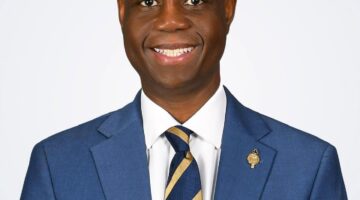
The late Damon J. Keith, sitting on the Cincinnati-based Sixth Court of Appeals, issued the ruling in 2002 on a First Amendment case. Another “minority” person, Praveen Madhiraju, helped craft it while serving as Wright’s law clerk.
The court unanimously ruled in favor of a lawsuit which the Detroit Free Press and other newspapers and the late Michigan Congressman John Conyers – also an African American — sued the George W. Bush administration over secret deportation hearings for suspected terrorists. The judges stated that such proceedings violated the First Amendment and they rejected the government’s national security argument. Wright, in his ruling, wrote, “Democracies die behind closed doors.”
Post reporter Bob Woodward popularized Wright’s assertion while writing in 2007 about the Watergate scandal that forced President Richard Nixon to resign and in 2015 during the 2016 presidential campaign. The Post adopted the wording “Democracy Dies in Darkness” in February 2017, a month after the start of Donald Trump’s first presidency. That was then.
Twenty years later, Amazon founder Jeff Beezos, who bought the 147-year-old Post in 2013, ordered it not to publish its draft editorial endorsing Kamala Harris for president in 2024. He mandated that future editorials must focus on “personal liberties and free markets.” Beezos does substantial business with the federal government and he reinforced that impression when he began to play nice with the newly reelected president. He kept that fact in the dark.
Beezos’ Amazon Web Services has a reported 10-year, $10 billion contract with the National Security Agency and his Blue Origin space exploration company has contracts with NASA worth more than $3.4 billion. The president can cancel those deals.
However, some of the president’s critics believe the Wright warning may be moot and that in the U.S. now democracy does not need darkness or closed doors to die. For example, the editorial board of the 173-year-old New York Times -The Post’s strongest competitor — called on May 1 for a national coalition to resist “a Power Grab” which it said was taking place. The Times, which is owned by a publicly traded company, with controlling interest held by the OchsSulzberger family since 1896, claimed that, in only his first 100 days in office, Trump did “more damage to American democracy than anything else since the demise of Reconstruction.”
Trump was “attempting to create a presidency unconstrained by Congress or the courts, in which he and his appointees can override written law when they want to. It is precisely the autocratic approach that this nation’s founders sought to prevent when writing the Constitution.”
The president, The Times asserted, “has the potential to do far more harm in the remainder of his term. If he continues down this path and Congress and the courts fail to stop him, it could fundamentally alter the character of American government. Future presidents, seeking to either continue or undo his policies, will be tempted to pursue a similarly unbound approach, in which they use the powers of the federal government to silence critics and reward allies.”
The Times acknowledged that Trump “is the legitimate President and many of his actions are legal” and “Some may even prove effective.” The paper noted also that Trump “won the presidency fairly last year, by a narrow margin in the popular vote and a comfortable margin in the Electoral College.” And it conceded also that its concerns may prove alarmist and it was possible that Trump’s “shambolic” – chaotic — “approach to governance will undermine his ambitions. Perhaps federal courts will continue to constrain him and he will ultimately accept their judgments.”
On the other hand, “his assault on the pillars of American democracy becomes even more aggressive and effective. If you listen to Mr. Trump’s own words, he is vowing just that. His larger strategy seems plain enough. He is trying to frighten people who might otherwise criticize him, and he is attempting to rig the political system so that his allies will have an easier time winning elections.”
The Times named Hungary’s Viktor Orbán, Turkey’s Recep Tayyip Erdoğan, India’s Narendra Modi and Venezuela’s Nicolás Maduro as examples of what could happen. Those men did not stage a “traditional coup” to gain power; they “originally won elections and then used their authority to amass more power.” Then they “repressed dissent, stifled speech, intimidated political opponents and tilted media coverage and election rules in their favor. Like them, Mr. Trump has signaled that he wants to consolidate power in himself.” Therefore, The Times maintained, “The task facing Americans today is to prevent this second scenario from coming to pass.”
Harvard political scientists Steven Levitsky and Daniel Ziblatt in their 2018 book “How Democracies Die” offered a similar analysis: “Blatant dictatorship— in the form of fascism, communism, or military rule—has disappeared across much of the world. Democracies still die, but by different means. Many government efforts to subvert democracy are ‘legal,’ in the sense that they are approved by the legislature or accepted by the courts. They may even be portrayed as efforts to improve democracy.” But that “democratic backsliding” could lead to a “hybrid regime.”
Andrew Marantz, who discussed “How Democracies Die” in a New Yorker article in April, argued that some anti-democratic policies could be implemented “under cover of darkness” but he too insisted that “much of it happens in the open, under cover of arcane technocracy or boring bureaucracy.” He interpreted “hybrid regime” to mean “not a totalitarian dictatorship, but not a real democracy, either. There are no tanks in the streets; there are elections, and public protests, and judges in robes. But, the more closely you look at its core civic institutions, the more you see how they’ve been hollowed out from within.”
Péter Krekó, a social scientist, explained to Marantz what happened in his native Hungary: “The way they do it here, and the way they are starting to do it in your country as well, they don’t need to use too much open violence against us. The new way is cheaper, easier, looks nicer on TV. Before it starts, you say to yourself, ‘I will leave this country immediately if they ever do this or that horrible thing,’ And then they do that thing, and you stay. Things that would have seemed impossible 10 years ago, five years ago, you may not even notice. It’s embarrassing, almost, how comfortable you can be. There are things you could do or say — as a person in academia, or in the media, or [a NonGovernmental Organization] — that would get them to come after you. But if you know where the lines are, and you don’t cross them, you can have a good life.”
Marantz acknowledged that some Trump policies were “escalations of preexisting trends, not fundamental discontinuities. … The corruption, the xenophobic nationalism, the ambient threat of decentralized violence—these may be more glaring now but, whether we like to admit it or not, they have been present throughout American history.” For example, George W. Bush “stretched Presidential powers well beyond their previous limits and Barack Obama expanded them even further.” But Trump’s second term had already represented “a sharp and menacing break,” with executive orders being used, for example, as “cudgels for Trump to wield against his enemies.”
John Ganz, who wrote the 2024 book “When the Clock Broke: Con Men, Conspiracists, and How America Cracked Up in the Early 1990s” delved into Trump’s three books for an explanation of what has led him to this point. He wrote in The Nation: “Trump puts a human face on capitalism. He represents both the aspirations and the grievances of people everywhere who feel its abstract power on their back but cannot understand it. He represents the possibility of success, and of revenge for the constant humiliations that living in a competitive society deals out. His brand says: ‘Be like me and you can make it too.’ He is the President of a country that has given up building and has given itself over totally to hucksterism.”



No Comment