






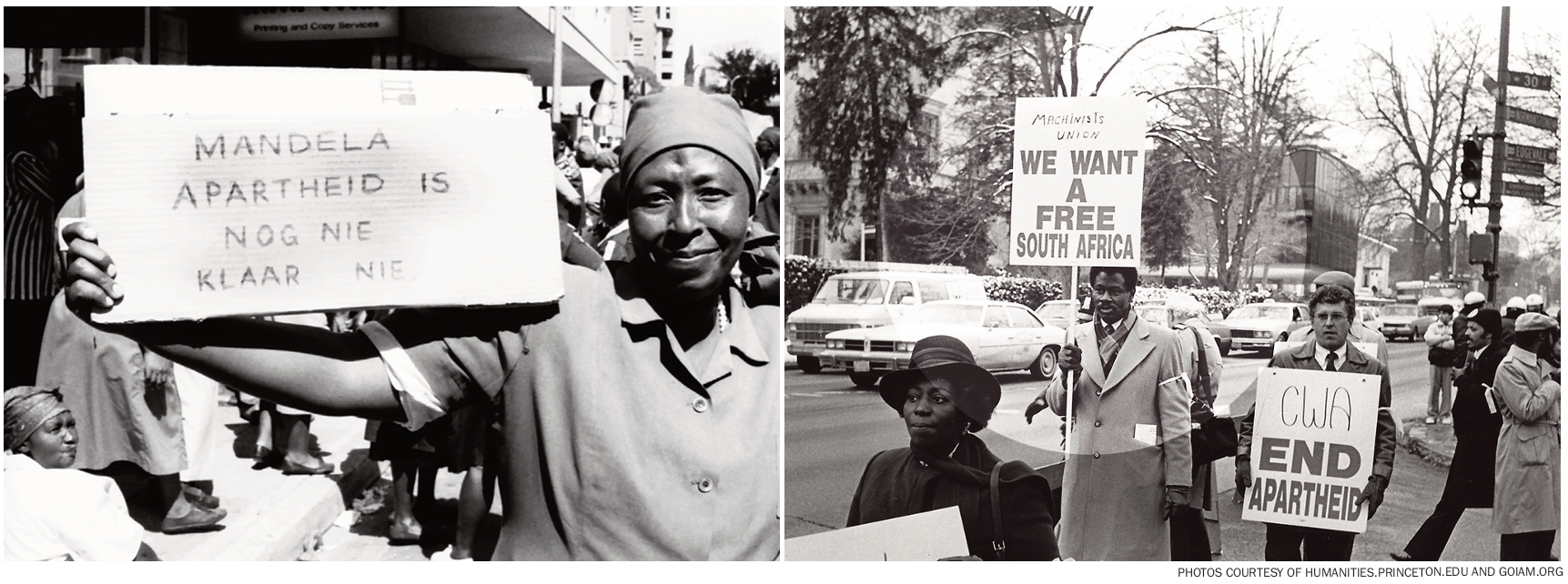
May 2024, South Africa and the world marked 30 years since the formal end of apartheid PHOTOS COURTESY OF HUMANITIES.PRINCETON.EDU AND GOIAM.ORG
History does not support President Donald Trump’s accusation that the South African government discriminates against white citizens.
African kingdoms existed for thousands of years in that part of the world. Then the first whites, Portuguese, arrived about 536 years ago, followed by Dutch colonizers – Boers or Afrikaners – 153 years
later, sent by the Dutch West India Company to establish a base to trade with Asia, then, later, by British and French “settlers.”
The newcomers took with them their concept of land as private property, while to the indigenous peoples – blacks – it was communal property.
Disputes quickly broke out as the colonizers seized more and more land, escalating to wars which lasted 100 years and ending
after Britain sent troops with rifles and cannon to impose white domination and formally establish a colony. Britain handed over power in 1910 to local politicians – all whites – who established the Union of South Africa.
The new state, which became independent in 1934, eventually imposed a system called “apartheid,” an Afrikaner word meaning "separateness" and reinforced it with laws dehumanizing the black majority.
A Natives Land Act permitted blacks – 80 percent of the population–to own or lease only seven percent of the land and restricted them to buying, renting or working the land only in specified “reserves.” They had to labor in diamond and gold mines or on white -owned land to eke out a living.
Their protests at being robbed of most of their land were harshly suppressed, until the African National Congress (ANC) led an armed struggle that eventually forced the regime to negotiate an end to apartheid and allow for elections which, for the first time, were based on the principle of one person, one vote, regardless of race, in 1994. The ANC, led by the late Nelson Mandela, won 62.6 percent or 22 million of the votes cast and he became South Africa’s first black president.
Instead of exacting retribution against the former oppressors, who had imprisoned him for 27 years, Mandela established a Truth and Reconciliation Commission to unify the nation. It provided a forum for victims and perpetrators of apartheid to talk about their experiences as a means of national reconciliation. No one was prosecuted.
But, to paraphrase Psalm 30:5, the weeping of the long night of apartheid did not end with the joy of independence in the morning. The land issue continues to cast a long shadow over development efforts and, 30 years later, the seven percent of citizens who are white still own more than three-quarters of the agricultural land.
Mandela also sought a peaceful way to resolve the land dispute. As part of the pact ending apartheid, he and the ANC had agreed that current owners would keep their land but the government would pursue reforming the tenure system to benefit tenants, while setting a goal of transferring 30 percent of the land from whites to blacks within five years. That never happened. After 20 years, only 10 percent of the land had been transferred to blacks and that situation has not changed much. “When the state has acquired land for restitution or redistribution, it has paid the owners full market value,” the Council on Foreign Relations reported. And that, too, was a lopsided policy because compensation for land stolen from blacks during apartheid was calculated on the basis of the value of the land when it was seized, not current fair market value.
With whites still owning most of the land, it has become evident that the government is having an uphill task pursuing major development and making a dent on large-scale black poverty. The Associated Press, citing a 2021 South African Human Rights Commission study, reported that “64 percent of black people were living in poverty, against one percent of white people.” The writer Eve Fairbanks paints a grim picture of promise unfilled in her 2022 book “The Inheritors: An Intimate Portrait of South Africa’s Racial Reckoning,” an edited excerpt of which ran in The Guardian.
Fairbanks points also to another hurdle which the government has been facing: the state of the country when the ANC took control. According to her, “the apartheid government was almost bankrupt when it handed over the reins to black people.” She likened it to selling “a used car on the verge of a breakdown to a family that only realized, when they got into it to drive it, that it was a piece of crap. But the family had no other options, so it became necessary for them to convince themselves they’d got something of great value.” One way to fix the “piece of crap,” of course, was land reform.
The Expropriation Act of 1975 required the state to compensate the land owner under the principle of "willing seller, willing buyer." However, a recently enacted law allows the government to seize land without compensation but only under certain circumstances, the BBC reported. Those circumstances include when confiscation is "just and equitable and in the public interest." Another condition is when the property is not being used and there is no intention to either develop or make money from it or when it poses a risk to people.”
Also, the new law resulted from “a five-year consultative process, as well as the findings of a presidential panel set up to look into the issue,” the BBC reported.
Some groups say they may sue the government and the United States, which did nothing to press for an end to apartheid until the 1980s has now entered the dispute – not on the side of the still suffering majority blacks but to support false claims by some whites about racial persecution.
President Trump signed an Executive Order in February ending “aid or assistance” to South Africa and “promote the resettlement of Afrikaner refugees escaping government-sponsored race-based discrimination, including racially discriminatory property confiscation.” News reports have indicated that the offer of asylum is being rejected.
But he also cited South Africa’s 2023 petition to the International Court of Justice to investigate Israel for potential genocide in Gaza and he criticized it for joining BRICS, a new international group comprising also Brazil, Russia, India and China.
But it is on land reform that Trump has turned the full presidential spotlight and the person directing the beam is Elon Musk. He is likely behind Trump’s insistence that land reform is part of a plot to get rid of whites. Such falsehoods are also promoted by the South African group AfriForum whose members the Southern Poverty Law Center has dubbed "white supremacists in a ‘suit and tie." An AfriForum delegation recently met the president at the White House.
They accuse the government also of “genocide” by failing to curb the killing of whites. However, The Associated Press reported that experts reject that allegation and added that “a group that records farm attacks says that 49 farmers or their families were killed in 2023, while there were more than 27,000 homicides in the country that year.”
Musk has a personal interest in pressuring the South African government. It has blocked his application for a license to operate his Starlink satellite internet service in the country until it meets a requirement that foreign companies must have a 30 percent local ownership. It is all transactional, while the poor suffer.
For his part, South Africa’s President Cyril Ramaphosa has declared that nobody will be driven off their land. “The people of this country know the pain of forced removals,” he has said. But he has also declared, “We will not be deterred. We are, as South Africans, a resilient people, and we will not be bullied.”
It is a pity that African American leaders, stalwarts in the ant-apartheid struggle, have not come out firmly in support of Ramaphosa and his government in this campaign to humiliate the country which taught the world that reconciliation is the way forward for a troubled world.


No Comment