









Editorial
By ElectricChoice.com
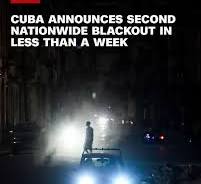
In March 2026, Cuba’s national electricity grid collapsed entirely — not for the first time, and almost certainly not for the last. The blackout left roughly 10 million people without power, knocked out water pumps, darkened hospitals, and brought the island’s already strained economy to a standstill.
The causes behind Cuba’s electricity crisis are layered: a grid built on Soviet-era technology, a near-total dependence on imported oil, decades of underinvestment, and an escalating geopolitical conflict that has choked off the country’s fuel supply. None of these factors alone explain what’s happening. Together, they do.
This article walks through the facts — what broke, why it broke, who’s affected, and what’s being done about it.
10M+People affected
3Island-wide blackouts in 4 months
~590 MWOnline vs. ~2,000 MW normal capacity
90%+Electricity from oil-fired plants
What Happened
Cuba has experienced at least three complete grid collapses between late 2025 and March 2026. The most recent, on March 16, 2026, was triggered by the failure of the Antonio Guiteras thermoelectric plant in Matanzas — the island’s single largest power station, with a capacity of approximately 330 megawatts.
When Guiteras went offline, the remaining generation capacity was insufficient to sustain the grid. Frequency dropped, automatic disconnections cascaded through the system, and the entire national grid collapsed within minutes. It was the third such event in four months.
Restoration has been painfully slow. By late March, only about 590 megawatts were online — less than a third of the system’s normal effective capacity of roughly 2,000 megawatts. In Havana alone, only about 5% of residents had power restored days after the collapse.
An Aging Grid Built for a Different Era
Cuba’s electricity infrastructure was largely built during the Soviet era. After the 1959 revolution, the Soviet Union supplied Cuba with cheap oil through non-commercial barter agreements, and the country used that fuel to build out a centralized grid of thermoelectric plants. By the late 1980s, over 95% of Cuban households had electricity access.
Several of these plants remain the backbone of the grid today:
| Plant | Location | Built | Technology | Capacity |
| Antonio Maceo (Renté) | Santiago de Cuba | 1966–1984 | Soviet | ~450 MW |
| Antonio Guiteras | Matanzas | 1988 | Japanese / Czech | ~330 MW |
| Máximo Gómez (Mariel) | Artemisa | 1980s | Soviet | ~300 MW |
These plants were designed for operational lifespans of roughly 100,000 hours. Most have far exceeded that mark. The Antonio Maceo plant, for example, operates at only about 65% of its installed capacity due to mechanical fractures in main vapor lines and other deterioration. Across the system, Cuba’s thermoelectric plants operate at an average of just 34% of capacity.
The total installed generation capacity is approximately 3,000 megawatts, but the grid’s effective (dependable) output is well below 2,000 megawatts on a good day. On a bad day, it’s a fraction of that.
The Fuel Problem
Even if Cuba’s plants were in perfect condition, they cannot run without fuel. Over 90% of Cuba’s electricity comes from oil-fired generation. The country produces only a small amount of crude oil domestically and depends heavily on imports — historically from Venezuela, and to a lesser extent from Mexico and Russia.
In January 2026, oil imports to Cuba dropped to zero for the first time since 2015. Only two small oil-carrying vessels reached the island in the first quarter of 2026: one from Mexico in January and one from Jamaica. That is a catastrophic shortfall for a country that needs a steady supply of heavy fuel oil to keep its aging plants running.
Why Did the Oil Stop?
This is where the story becomes more contested.
The Cuban government has pointed to the United States as the primary cause. In January 2026, the Trump administration cut off Venezuelan oil shipments to Cuba and threatened tariffs on other countries that exported oil to the island. Mexico subsequently suspended planned shipments. Cuba describes this as an “oil blockade” that has deliberately strangled the country’s energy supply.
The U.S. government’s position is that sanctions are a response to the Cuban government’s human rights record and that the embargo is longstanding policy, not a new escalation.
Critics of the Cuban government argue that blaming sanctions alone ignores decades of mismanagement: the failure to diversify energy sources, the lack of investment in grid maintenance, and the government’s reliance on subsidized oil from political allies rather than building domestic capacity. From this perspective, the sanctions are the proximate trigger, but the underlying vulnerability is largely self-inflicted.
Both of these things can be true at the same time. Cuba’s grid was fragile long before the 2026 oil cutoff, and the oil cutoff has made a fragile situation catastrophic.
The Humanitarian Cost
Whatever the political debate, the human impact is not in dispute.
Water: Nearly one million Cubans depend on tanker trucks for drinking water. 84% of pumping equipment requires electricity — when the grid goes down, so does the water supply.
Healthcare: Five million residents live with chronic illness. Thousands of cancer patients need continuous treatment. Over 32,000 pregnant women rely on functioning hospitals. Women have given birth in completely dark facilities.
Food: Refrigeration failures spoil perishable food in a country already dealing with shortages. Residents cook communal meals outdoors using wood and charcoal, pooling whatever supplies remain.
Daily Life: Blackouts are no longer exceptional — they are the baseline. Residents charge phones when brief windows of power appear. Economic activity beyond subsistence has largely stopped.
“Humanitarian pressures are growing” as energy shortages compound existing challenges around food security, healthcare access, and emigration.
— United Nations, February 2026
What Cuba Is Doing About It
Cuba is not standing still, though the scale of the challenge far outpaces the pace of investment.
92Solar parks planned by 2028
2,000+ MWNew solar capacity target
$1B+Invested in solar program
24%Renewable target by 2030
Solar Expansion
The most significant initiative is a China-backed program to install 92 solar parks by 2028, with a combined capacity exceeding 2,000 megawatts. China has donated 22 solar parks (capable of generating about 120 MW) and provided technology, materials, and expertise for others.
As of late 2025, 32 solar parks were synchronized with the national grid, with a target of 51 by end of year. The country invested over $1 billion in the program, much of it from domestic resources. Cuba’s stated goal is 24% renewable electricity generation by 2030, up from less than 5% today.
Russian Assistance: Russia has committed to modernizing three existing oil-fired power plants and constructing a new 200 MW plant. Timelines and progress have been less well documented.
Battery Storage: Storage systems are being installed at four locations to stabilize grid frequency and reduce the automatic disconnections that trigger cascading failures.
Context: How Cuba Compares
Cuba’s crisis is unusually severe by global standards, but it is not without parallel. Electricity infrastructure failures tend to follow a common pattern: aging systems, fuel dependence, underinvestment, and an external shock that pushes a fragile grid past its breaking point.
| Year | People Affected | Root Cause | |
| Cuba grid collapses | 2025–2026 | ~10 million | Fuel shortage + aging infrastructure |
| Puerto Rico (Hurricane Maria) | 2017 | 3.4 million | Hurricane + aging infrastructure |
| Texas (Winter Storm Uri) | 2021 | 10+ million | Extreme weather + grid isolation |
| Lebanon rolling blackouts | 2020–present | ~5 million | Fuel shortage + fiscal collapse |
| South Africa load shedding | 2023–2024 | ~60 million | Aging coal plants + underinvestment |
The comparison to Puerto Rico after Hurricane Maria is particularly instructive. Puerto Rico’s grid was also aging, underfunded, and overly centralized. When Hurricane Maria destroyed it in 2017, full restoration took 11 months. The lesson drawn from that disaster — that centralized, single-fuel grids are inherently fragile — applies directly to Cuba.
What Comes Next
Cuba’s electricity crisis has no quick fix. Even if fuel imports resume tomorrow, the grid’s structural deterioration means blackouts would continue at some level. And even if every planned solar park comes online on schedule, the 2,000 MW of new capacity will take years to build out and still needs battery storage to serve nighttime demand.
In the near term, the trajectory depends heavily on two factors that are largely outside Cuba’s direct control: whether fuel shipments resume at meaningful volumes, and whether international investment (particularly from China and Russia) accelerates or stalls.
In the longer term, Cuba’s experience may become a case study in what happens when a national grid is built on a single fuel source, maintained at subsistence levels, and then subjected to a supply shock. It is a pattern that has played out before — in Puerto Rico, in Lebanon, in South Africa — and will almost certainly play out again.
What makes Cuba’s situation distinct is the sheer totality of the failure. This is not rolling blackouts or regional outages. It is a complete, repeated collapse of the national grid serving an entire island nation. For the 10 million people living through it, the political debates are secondary to a much simpler reality: the lights are off, the water isn’t running, and no one can say when either will come back.


No Comment