









Photos courtesy of FACEBOOK and STOCK
By TIFFANY CHARTIER Senior Production Editor Yahoo Associated Press Staff Report
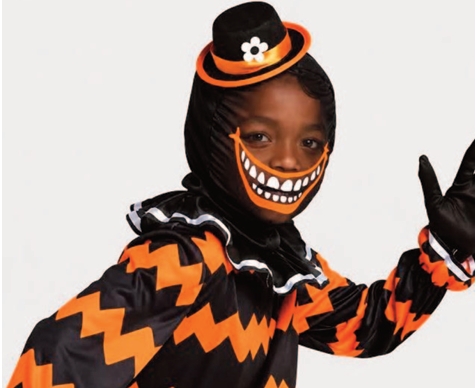
Target apologized and removed a children’s Halloween costume after so cial media users said its dark face covering, exaggerated grin, and oversized teeth resembled blackface and racist caricatures from 19th-century minstrel shows.
In an August 24 statement, Target called the costume “offensive,” said it should never have been included in its assortment, and is reviewing how the costume entered its assortment. Costume Draws Comparisons to Minstrel Imagery The product was listed as the “Kids’ Glows Under Blacklight Circus Clown Halloween Costume” under Target’s Hyde and EEK! Boutique brand, according to Reuters.
Although Target disabled the original product page after withdrawing the costume, viral images of the costume have been circulating on social media.
Promotional photographs showed a Black child wearing an orange-and black suit, black gloves, and a dark hood or mask bearing a broad white smile and large teeth.
The outfit also included a small top hat. Critics said the mask, exaggerated grin, gloves, and model’s pose evoked blackface minstrelsy.
The Smithsonian’s National Museum of African American History and Culture states that early minstrel performers blackened their faces and portrayed Black people through demeaning stereotypes.
Target removed the costume after the criticism spread.
Target Says Costume Was ‘Offensive’ Target published an official apology on August 24 and said it was investigating how the costume became part of its assortment.
“As a company, we know we got this wrong, and we are deeply sorry,” the company said in its official corporate statement. “The costume is offensive and should never have been part of our assortment. It is no longer available for sale. We know this is especially hurtful for our Black guests, team members and partners. Removing the costume is an important first step, and the company is looking closely at how this happened and what needs to change to ensure this won’t happen again.”
Target’s statement did not identify the costume’s designer, disclose how many units had been sold, or explain who approved it.
Hyde and EEK! Boutique is included among Target’s owned brands in the retailer’s most recent annual report, distinguishing the clown outfit from independently branded merchandise sold through Target’s website.
The incident comes as Target continues to face scrutiny over its product and corporate-policy decisions.
The Dallas Express previously reported that the retailer’s 2026 Pride Month displays were substantially smaller and placed greater emphasis on patriotism.
In 2023, The Dallas Ex press covered Target’s sponsorship of Dallas Pride despite calls for a boycott over the retailer’s Pride merchandise
Retailers Have Faced Similar Controversies
This is not Target’s first Halloween costume withdrawal.
In 2009, the retailer stopped selling an “Illegal Alien” costume after immigration advocates complained.
The $39.99 outfit included an extraterrestrial mask, an orange jumpsuit bearing the words “Illegal Alien,” and a mock green card, according to an Associated Press report published by Minnesota Public Radio.
Other controversies have involved mental illness and cultural portrayals rather than caricatures of Black Americans.
In 2013, British supermarket chains Tesco and Asda withdrew separate costumes depicting people with mental illnesses. Tesco’s orange “Psycho Ward” outfit carried the word “committed,” while Asda offered a bloodstained “Mental Patient” costume.
Both companies apologized following complaints from mental health organizations, according to contemporaneous reports from The Guardian.
Disney withdrew a children’s Maui costume tied to its film “Moana” in 2016.
The brown bodysuit included full-body tattoos, a shark-tooth neck lace, and a leaf skirt.
Some Pacific Islanders compared the costume to blackface because it placed children in another group’s skin color.
Disney apologized and stopped selling it online and in stores, according to an Associated Press report.
Where Do Retailers Draw the Line?
Target’s decision also raises a broader question:
Why was the clown costume removed while other products that could offend particular groups remain available?
Target currently lists a $39.99 adult cracker-and-cheese costume from Imposta Costumes.
Although “cracker” can be used disparagingly toward rural White Southerners, as the New Georgia Encyclopedia explains, the product depicts a literal snack cracker covered with cheese.
Target also sells fake “hip-hop” teeth grills advertised for costume parties and music videos. Worn alone, grills can be a fashion accessory rather than a racial caricature.
However, researchers examining racialized Halloween costumes have found that fake gold teeth, oversized chains, Afro-style wigs and similar accessories have also been combined to create generic “rapper,” “pimp” or “ghetto” portrayals that parody stereotypes of Black Ameri cans—even without blackface—according to a peer-reviewed study published in Qualitative Sociology.
The same disagreement surrounds the “blind referee” costume sold by Spirit Halloween.
The costume turns a familiar complaint about sports of officiating into a visual joke through dark glasses and a white cane. How ever, disability advocates have argued that such costumes make visual impairment synonymous with incompetence.
The American Foundation for the Blind has similarly criticized entertainment that relies on the “blind referee” stereotype, while also noting that some blind people use the joke themselves.
Costumes portraying demanding “Karen” figures, nagging wives, elderly people, hillbillies, prisoners, clergy members, caricatured politicians, and other familiar figures could likewise be considered insulting by members of the groups being portrayed.
There is no universal or legally binding test determining when a humorous costume becomes offensive merchandise.
The clown costume differed in two significant respects.
It was sold under Target’s own Hyde and EEK! Boutique brand, while several potentially controversial products on Target.com come from outside vendors.
Critics connected its dark mask, exaggerated mouth, and oversized teeth to documented minstrel-show imagery historically used to demean Black Americans.
Target did not specify which elements it considered objectionable, but it called the costume “offensive” in its official statement.



[…] 📖 Read Full Article […]