





Photo courtesy of STOCK
By David L. Snelling
South Florida Times
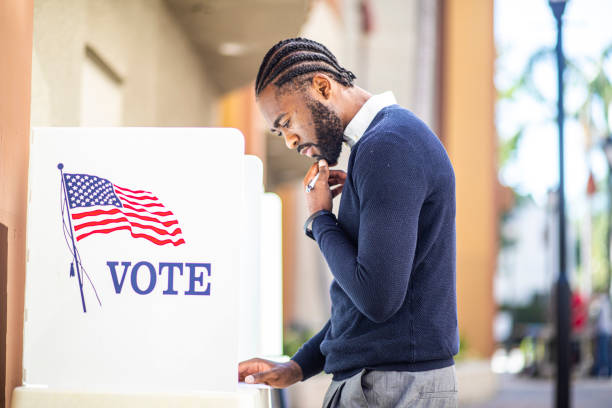
Pushing back on a nationwide mid-decade redistricting to give Republicans more seats in U.S. Congress and the supreme court gutting the 1965 Voting Rights Act, the NAACP has launched a $20 million Black voter mobilization campaign for the midterm elections.
The nation’s oldest civil rights group said Blacks could lose a vast majority of representation in the U.S., sweeping them back to the Jim Crow era and the Civil Rights struggle during the 1960s.
The mobilization campaign is designed to increase Black voter turnout for the November 3, 2026 election, as the NAACP is aiming for 6.5 million people to show up at the polls.
The organization, which has local branches in Miami-Dade, Broward and Palm Beach counties, said it’s the largest get-out-the vote campaign for a midterm election in its 117-year history.
Since the U.S. Supreme Court further undermined federal voting rights protections in April, the responsibility of protecting Black voting power has shifted largely to states and civil rights organizations, and the NAACP is taking up the charge using a decades-old method.
“This isn’t necessarily a change of priorities,” Tyler Sterling, the national director of campaigns for the NAACP, told reporters. “It’s staying on that same path to ensure that the democracy that Black voters have fought so hard to maintain still works for us.”
NAACP President and CEO Derrick Johnson said the upcoming election is critical for Blacks.
“Not voting is not an option,” he said. “Everything you care about: healthcare, education, police accountability, clean air — it all comes back to the ballot box. That’s why the NAACP is making our largest GOTV investment ever: $20 million to mobilize 6.5 million Black voters across 14 states and 33 congressional districts, with a recruitment goal of 20,000 volunteers.
Almost a third of the membership of the Congressional Black Caucus, 19 of its 62 members, are at risk of losing their seats through the 2028 election cycle.
Republicans in southern states where they control the legislature have redrawn congressional maps less than two weeks after the Supreme Court dealt a blow to Section 2 of the Voting Rights Act.
Republican governors answered President Donald Trump’s call to shift Congressional districts to GOP-leaning areas to bolster their chances at keeping control of the U.S. House of Representatives.
Florida Republican Gov. Ron DeSantis and the GOP-controlled Legislation revamped Congressional districts in May 2026 to add to their advantage.
Currently, 20 Republicans in Congress from Florida have 20 seats and 8 for Democrats.
Florida’s redrawn map split Democrats in Broward County, when U.S. Rep. Debbie Wasserman Schultz decided to run for CD 20, which has a Black representative since 1992, after her district was shifted to a Republican stronghold.
Wasserman Schultz won the seat in the August primary after facing backlash from her own party and candidates for the seat, including former U.S. Rep. Sheila Cherlifus McCormick, former Broward County mayor Dale Holness and rap pioneer Luther Campbell.
With the general election in November, Blacks in South Florida are guaranteed one seat, CD 24, which retiring U.S. Rep. Frederica Wilson has represented for 16 years.
The district covers North Miami-Dade County including Brownsville, Liberty City, Opa-locka Miami Gardens and Broward’s West Park.
Democrat Oliver Gilbert, a former Miami-Dade County Commissioner, emerged victorious in the primary and faces Republican candidate Mayonna Te Brown who is facing criminal charges in an Illinois courtroom.
Wilson endorsed Gilbert over seven other Democratic candidates in the race including former state Senator Shervin Jones who finished second and Kendrick Meek II, whose grandmother Carrie Meek and father Kendrick Meek represented the district in Congress.
In an effort to reach 6.5 million Black voters, the NAACP’s campaign will cover the full arc of the election cycle, from voter registration and door-to-door canvassing to community events and voter education through Election Day.
The campaign will also include radio advertisements and other spots.
The organization has divided the 33 congressional districts into two tiers based on where it believes that its campaign can have the greatest impact.
Sterling identified districts in states including Michigan and New York as among its top priorities, while adding that the NAACP is also investing heavily in down-ballot races across the south for positions such as sheriff and county commissioner.
“We’re not resting on our laurels,” Sterling said. “We’re using this muscle that is civic engagement to ensure that Black voters are protected, have representation, and can participate in our democracy.”
Daniella Pierre, president of the NAACP Miami Dade chapter, told the South Florida Times that her group of volunteers has been reaching out to people and encouraging them to vote way before the $20 million Black voter mobilization campaign was launched.
“We are always continuing to do the work, it’s not a new role for us,” she said. “The announcement of the additional dollars will help us greatly but we have been doing this since the establishment of the NAACP.
Pierre said her volunteers are taking the voting drive to local churches, and recently paid a visit to Jordan Grove Missionary Baptist Church in Liberty City.
She said the local NAACP branch has signed up more people to register to vote, assisted them with voting by mail and reminded them of the November 3, 2026 election date and early voting.
Pierre also said the NAACP is also bringing its election readiness events to local communities and underscoring the importance of voting in the upcoming election on social media.
Like the August 18, 2026 primary, Pierre said the NAACP is holding town hall forums for local non-partisan candidates like the November run off election between Miami-Dade County School Board candidates Katrina Wilson and Linda Cothiere Aristide.
They were the two-top vote getters in the primary among seven candidates and were forced into a run-off when neither candidate collected at least 50 percent of the vote to win outright.
The NAACP will also host a town hall forum for city of Opa-locka Commission candidates and are holding out hope for a Florida gubernatorial forum between Republican and U.S. Rep. Bryon Donalds and Democrat David Jolly, a former Republican congressman who switched parties.
Political journalist and radio host Roland Martin is also stressing the importance of Black voting for the November election.
He said Blacks more than ever need to vote to beat Trump and Republicans at their own game.
“The upcoming elections demand a powerful response from Black voters,” he said “Mobilization is key to influencing outcomes, especially in crucial states like Alabama.”

No Comment