










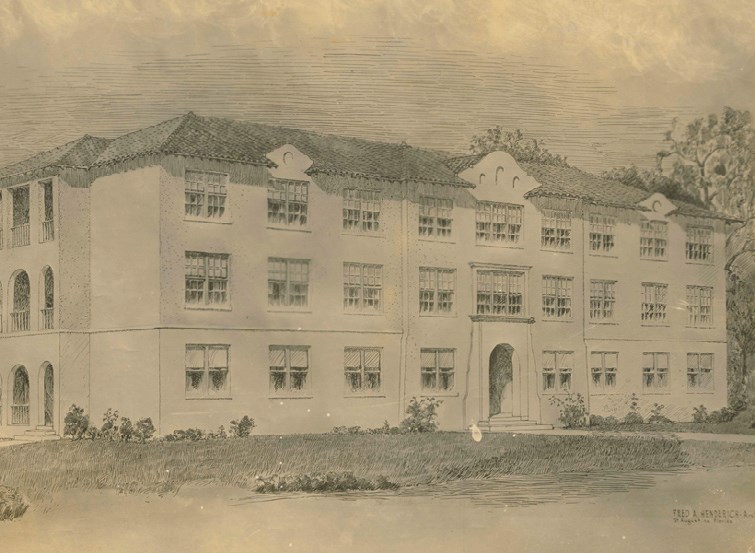
A sketch of the Florida Normal & Industrial Institute, which is now Florida Memorial University. PHOTO COURTESY OF FMU
By David L. Snelling
Miami – Florida Memorial University Foundation has agreed to lease land in St. Johns County for the state to build the first ever state-regulated Black History Museum, according to the Tallahassee Democrat.
Miami-Dade County’s only HBCU would not confirm the deal but state Sen. Tom Leek, a Republican from North Florida, filed a bill to officially name St. Augustine in St. Johns County as the site for the museum.
FMU has owned the 17-acre site since the 1960s when it was known as Florida Normal and Industrial Institute before moving to Miami-Dade.
Leek’s bill ends any hope for the City of Opa-Locka, Orange County and other entities in Florida landing the museum honoring Black pioneers who made an impact on American history.
A nine-member task force awarded St. Johns County the museum in 2024, but the Republican-controlled Legislature delayed giving its final approval after several lawmakers wanted the group to go back to the drawing board.
They felt several lawmakers, who also served on the task force, influenced the decision without giving other locations a fair shot after presenting their plans and designated sites for the museum.
The museum’s location was at the center of a dispute that intensified over the task force’s 10 meetings between members who favored St. Johns and others who wanted Eatonville in Orange County to be the site.
Orange County Democratic Rep. Bruce Antone, who pushed for the Legislature to create the task force but wasn’t part of it, said the St. Johns location was inadequate because it was underdeveloped and isolated.
With the bickering, the negotiations between St. Johns and FMU Foundation to lease the property were put on hold.
However, the task force stuck with its original decision and forwarded the final report to Gov. DeSantis.
“As we recognize February as Black History Month, I am proud to file Senate Bill 466 as we move forward as the preferred location for the Florida Museum of Black History,” Leek said in a press release. “The museum will be built on the former site of Florida Memorial University, which has historical significance here in St. Johns County, and I look forward to working with our community and our state in furtherance of this significant designation.”
Among the finalists was Opa-locka which offered to purchase a 4.5-acre site at 200 Opa-locka Blvd., with two buildings at nearly 50,000 square feet of space.
The Miami-Dade County Commission supported the city’s bid to buy the land from a private developer.
In a proposal, St. Johns County and St. Augustine were described as “steeped in the African American experience from the West African influence of the Gullah Geechee people to the contemporary leaders and trailblazers, such as Dr. Otis A. Mason, the first elected Black superintendent of schools in Florida.”
In addition, the first free Black settlement in the U.S. was in St. Augustine in 1738 and was the site for a series of civil rights protests that led to the passage of the 1964 Civil Rights Act.
“The community of St. Johns County has a strong track record of partnership and coordination focused on historic and cultural events,” St. Johns officials said in the proposal. “Together, we know we can seamlessly integrate the St. Johns County-based Florida Museum of Black History into the experience, creating a memorable immersive educational experience for all those who visit.” Orange County Democratic Rep. Bruce Antone, who pushed for the Legislature to create the task force but wasn’t a part of it, said the St. John’s location was inadequate because it was underdeveloped and isolated.
Once built, the Black Museum will highlight different Black cultures in Florida, spanning from the 19th century through Reconstruction, the Jim Crow era, and the Civil Rights Movement.
The museum will also feature contributions from African American veterans, including the Tuskegee Airmen, and materials related to state educator and civil rights activist Dr. Mary McLeod Bethune.


No Comment