









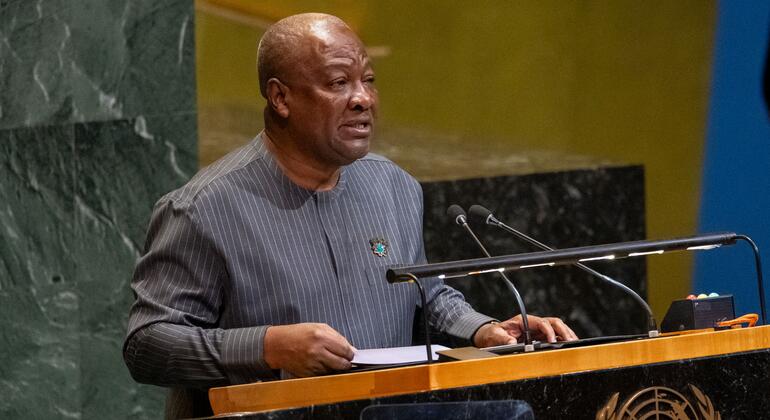
John Mahama, President of Ghana
By Antonia Williams-Gary
On March 25, 2026, after nearly a millennium of the inhumane practice, the United Nations General Assembly voted to declare the transatlantic slave trade “the gravest crime against humanity”!
Vote: 123 For, 3 Against and 52 Abstentions.
Africa and the Caribbean are on the rise in their unanimous support of the Resolution which declared that transatlantic slavery enterprises were inhumane.
Led by Ghana President John Mahama, Resolution 80/48 was designed to ensure there is a “safeguard against forgetting” those historical events or efforts to write them out of history.
Predictably, the USA, voted against the Resolution, because of the references to “reparations” and international law at the time did not prohibit the practice; stating as a defense that importation of slaves into the country was legal until 1808; chattel slavery ending in 1865 with passage of the 13th Amendment.
Also voting “no” was Israel which has a confusing and conflicted history, and Argentina which has a history of removing Blacks from its country.
Expectedly, the UK and all 27 countries of the European Union were among 52 countries which abstained from voting. Their respective rational was widely divergent.
Of course, the elephant in the room was the specter of reparations.
Let’s be clear: there are not enough resources in the world to directly pay each of the victims and all the descendants of racist chattel slavery; no treasury is large enough to make a monetary payment commensurate with the current value of “stolen” lives.
No, in this case payment of reparations is synonymous with justice, which can be measured by many means. The carefully crafted words of the Resolution hone the point of seeking “reparatory justice”, e.g., apologies, restitution, rehabilitation, and compensation for the “historical wrongs” of slavery.
At this point, I am moved to make a comparison of the “lest we forget” Resolution adopted by the UN in 2005 in recognition of The Holocaust- that specific event perpetrated against European Jews by the Nazi regime- and the most recent resolution.
They both address historical atrocities. UN Resolution 60/7, The Holocaust Remembrance (Lest We Forget), is a future oriented measure focused on memorializing the atrocities, educating the public about the events, and adopting measures to prevent another such occurrence.
On the other hand, the UN Resolution on slavery is backward and forward-looking, adopted to correct a set of past inhumane practices whose consequences are still lingering, and which have for far too long, been underrepresented in the recorded lexicon of significant historical events.
Tellingly, there is a movement underway in the USA to suppress, remove, deny and erase Black history in public school textbooks and curricula, in museums and across public places.
For example, The (Smithsonian) National Museum of African American History and Culture is under attack by the Trump Administration with orders to survey its artifacts, edit narratives, and soften the language used to explain events. Also, murals have been removed; military bases have had names of Blacks replaced, appointed Black officials have been fired.
We must not allow these erasures to continue. The UN Resolution on Slavery has issued a wakeup call to Blacks and those who seek justice in the USA, and throughout the world.
Symbolically, it was not lost on me that the Ghanaian President presented the Resolution. A popular Ghanaian term and symbol is “Sankofa” depicted as a bird which has its head turned backward while the body is moving forward. It means “to go back and fetch it”; reflecting on the past is crucial for progress and building on the future.
Hence, the UN resolution is simply another example of Sankofa!
Maya Angelou’s poem ‘I Rise’ opens with this line: “You may write me down in history with your bitter, twisted lies….” It is a poem to the joy of overcoming wrongs visited on Black folk in this country, from enslavement to Jim Crow, from disenfranchisement to discrimination, and to having the resiliency and wherewithal to call for reparatory justice in every form possible.
The UN has finally codified our struggle, worldwide, and for that we should prepare to take the next steps.
Black Lives Matter!
Toniwg1@gmail.com



No Comment