








Photo courtesy of www.freepick.com
By David L. Snelling
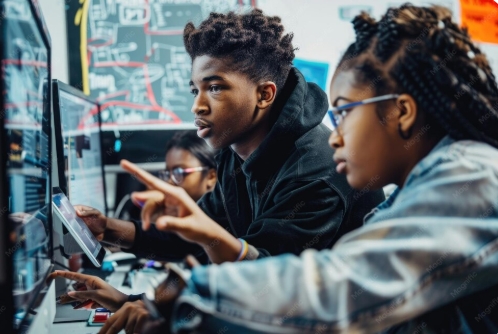
Black high school students said they have been unfairly accused of cheating using Al to finish their schoolwork including science projects, according to a study.
Teachers nationwide have falsely accused Black students of using AI, compared to their counterparts who were flagged less accused of cheating in the classrooms.
In a survey conducted by Common Sense Media, 20 percent of Black teens reported that a teacher had incorrectly flagged their assignment as AI-generated, compared with 7 percent of white teens and 10 percent of Latino teens.
Overall, 10 percent of teens said they had been falsely accused in this way, per Education Weekly.
The accusations occur against a backdrop of widespread classroom use of AI detection tools.
The survey said 460 public school teachers in grades six through 12 found that 68 percent regularly employed such software.
Among teens whose work was wrongly flagged by a teacher, 79 percent said the assignment had also been run through AI detection software, while 27 percent said it had not been checked by any such tool.
The problem is not limited to Black students.
Researchers have shown that AI detectors can misidentify writing by non-native English speakers.
Seven widely used tools incorrectly labeled more than half of essays written by Chinese students taking the Test of English as a Foreign Language as AI-generated, while correctly identifying essays by U.S. eighth-grade students as human-written.
According to Academia Consulting.com, whether using AI for schoolwork is cheating depends on how the student uses it, what the assignment requires, and the institution’s policies.
For example, if the student uses AI to complete the assignment entirely or to bypass the learning process, it’s generally considered academic misconduct, even without intent to deceive.
Submitting AI-generated work as your own without disclosure violates most academic integrity policies.
Acceptable uses, with instructor approval, include brainstorming, outlining, grammar/spelling correction, or helping understand complex topics.
Unacceptable uses include submitting AI-written essays, student’s rewriting their own work with AI edits, or using AI to generate answers on take-home exams or problem sets.
Some schools ban AI entirely; others allow limited uses like editing or research assistance; some integrate AI into learning in a transparent way.
Educators are concerned over AI, which can help students produce polished, accurate work in seconds, making it hard to assess if learning actually occurred.
According to Future Education Magazine, many teachers now prefer in-class or monitored assignments to reduce misuse
Without clear rules, students may feel uncertain about acceptable uses, leading to guilt or confusion.
Taylor McGee, assistant professor at Christopher Newport University, reviewed the Commons Sense Media study, “The Dawn of the AI Era,” and learned that Black students reported that they were about twice as likely to have their work incorrectly flagged as generated by artificial intelligence tools as their white and Latino peers.
McGee subsequently launched her own research project to delve into the matter and discovered Black students are targeted for their cultural stereotypes.
“We know a lot about how Black students are penalized and pushed out of schools for things that are cultural expressions—Black girls receiving out-of-school suspensions for their choice of physical expression, including hairstyles and clothing, engaging in the cultural tradition of call-and-response,” McGee says.
And while the educators’ implicit biases are likely playing a part in the false accusations reported in the Common Sense Media study, McGee also points out that these same biases are baked into AI-detection tools.
She said she plans to further examine these potential biases in her research, both at the educator level and in the AI-detection tools that they are using.
“Bias is transmitted through educational experiences, and AI is becoming an increasingly central part of how those experiences are shaped,” says USC Rossier Professor of Research Kendrick Davis, who is a part of the study’s research team. “As these tools influence how students are judged, supported and afforded opportunity, we have to ensure—in both practice and policy—that they are not reproducing the very structural barriers education is supposed to dismantle.”
Photo courtesy of www.freepik.com

No Comment