










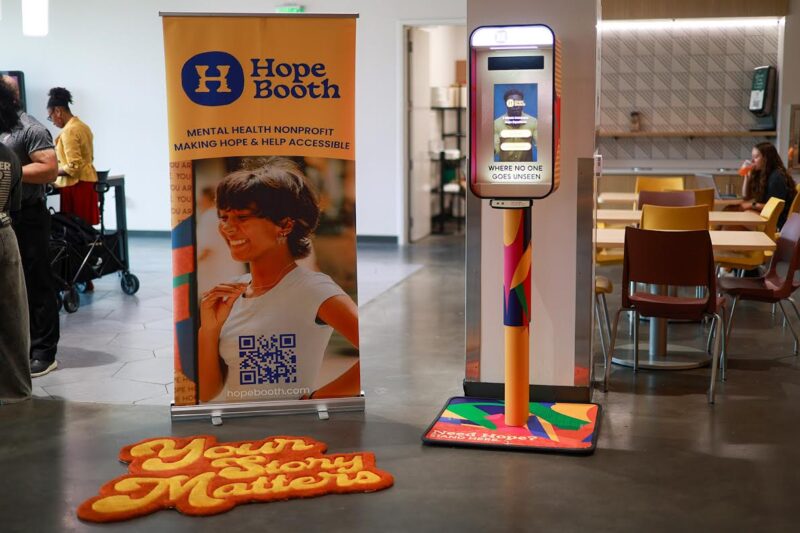
The Interactive Hope Booth is located inside the Student Union on the campus of Florida State University (Photo courtesy of FSU).
By David L. Snelling
South Florida Times
MIAMI – College students in the U.S. are struggling with mental health challenges, impacting their academic performances, losing interest in their studies and causing some to drop out with an uncertain future.
According to a study conducted by Science Insights.org, college students experience high rates of anxiety, stress, depression and other mental health issues that affect their overall well-being.
In addition, the pressure of achieving academic success and family issues bring down students to the point of turning to alcohol and substance abuse during their mental health struggles.
While most colleges and universities offer counseling and mental health services to students, Florida State University has installed the Interactive Hope Booth to support student mental health.
FSU has become the first college campus in the nation to install a Hope Booth, an innovative resource designed to expand access to mental health support.
Located on the first floor of the Student Union, the booth offers an interactive video experience designed to deliver immediate encouragement and support.
“Florida State is actively fighting to help break down the barriers and stigma of mental health concerns,” Vice President for Student Affairs Amy Hecht said. “We are grateful to offer the Hope Booth on campus, expanding our wellness support with this innovative resource.”
Atlanta-based Hope Booth is a mental health and suicide prevention nonprofit whose mission is to deliver hope and connect individuals to free support and resources.
Hope Booth’s programming is developed in collaboration with a board of mental health experts, ensuring all content is grounded in evidence-based practices.
Hope Booth is available for not only students, but faculty and staff as well.
It includes a viewing screen and closed captioning accessibility, where students answer several questions about their mental health.
The narrator then offers encouraging words of hope and action steps such as deep breathing or repeating positive words of affirmation.
Gloria Umanah, founder and CEO of Hope Booth, spoke to students and staff who gathered at the Student Union during the unveiling.
She asked them to think of their mental health as performing maintenance on a vehicle with certain steps car owners can take to help keep the car running before the check engine light comes on.
“We think mental health care should be the same,” Umanah said. “You don’t have to be on the verge of crises. What does it look like to take care of our mental health, to rejuvenate our own hope and then spread that hope everywhere we go so eventually we pioneer a movement where no one goes unseen?”
The installation cost for Hope Booth was $25,000, which was funded through the Stanley 1913 Creators Fund and will remain on campus for at least two years.
Umanah said Hope Booth has become popular since it debuted in 2021 with installation in 18 states and three countries.
Hope Booth comes at a crucial time for college students as more are finding it difficult to deal with mental health struggles.
Science Insights.org suggests that 37 percent of college students nationwide report moderate-to-severe depression symptoms and 32 percent report significant anxiety.
A 2023–24 Healthy Minds Study found 47 percent screened positive for anxiety or depression, yet fewer than half received counseling in the past year.
About 13 percent reported contemplating suicide in the past year, and 76 percent experienced moderate or high stress in the past month.
About 45 percent of college students reported overwhelming anxiety in the past year and 30 percent have been diagnosed with depression.
According to the American Council on Education, mental health challenges impact students’ academic performances.
About 77 percent of students said mental or emotional difficulties negatively impacted their grades for at least one to six days in the past month.
Students with poor mental health are twice as likely to drop out of school.
A significant number of FSU students are dealing with mental health challenges, according to the State University System of Florida.
Research and FSU’s own Student Resilience Project show that college students at FSU experience high levels of stress, anxiety, and other mental health concerns.
In a campus survey, 30.2 percent of students reported stress, 21.6 percent reported anxiety, and 20.6 percent reported sleep issues as top barriers to academic success.
National studies cited by FSU indicate that 35–50 percent of young adults enter college with mental health issues, and many first develop mental health disorders by the age of 24.
The challenges can include depression, anxiety disorders, trauma-related conditions, and substance use issues linked to coping with academic and social pressures.
Carlos J. Gómez, FSU’S associate vice president for Health, Wellness, and Safety and dean of students, said Hope Booth was placed at the Student Union for visibility.
“In the first 10 days, 374 individuals have used the Hope Booth,” Gómez said. “We are pleased to create another space on campus where students can pause, reflect and connect with mental health resources.”
Yvonne Langdon-Maduekwe, director of FSU Counseling & Psychological Services (CAPS), said Hope Booth provides students with a space to engage in guided, evidence-based activities designed to reduce stress, build resilience and promote emotional well-being.
“It’s another step toward fostering an even healthier supportive FSU community,” Langdon-Maduekwe said. “Seeing students consistently come to CAPS each year demonstrates the need for mental health support amongst college students and highlights the value of these supports on our campus.”
CAPS served more than 12,000 members of the FSU community in the 2025-2026 academic year.
“Through outreach, CAPS not only provides education and prevention services, but also ensures that we are visible and accessible to the students, allowing them to seek the support they need,” said Rebecca Whitfield, associate director for Treatment Coordination and Outreach for CAPS.

No Comment