








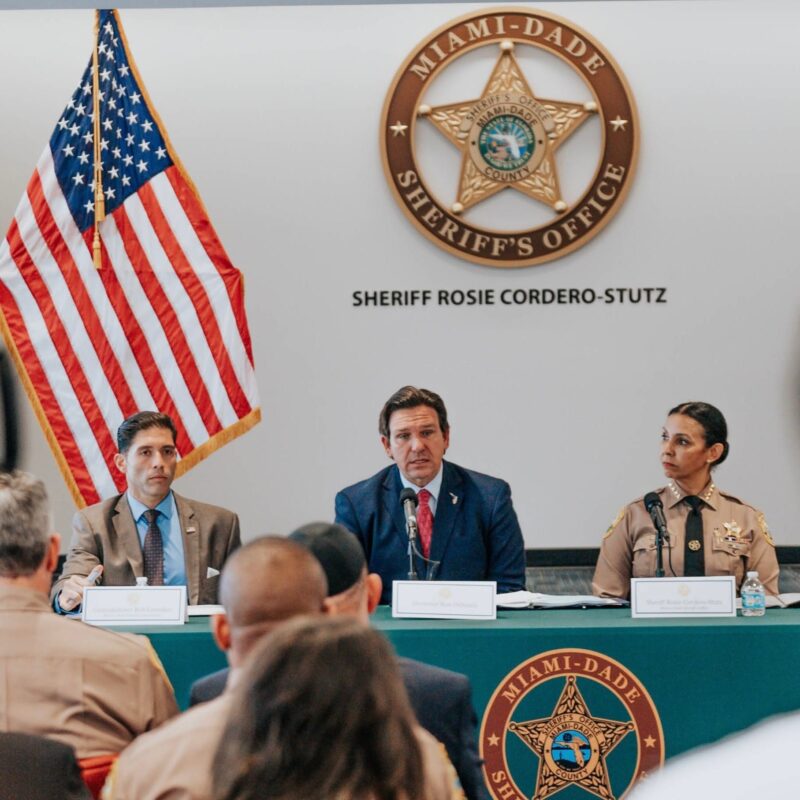
Miami-Dade County Commissioner Roberto Gonzalez, Florida Gov. Ron DeSantis and Miami-Dade County Sheriff Rosie Cordero-Stutz participate in a round table discussion on Amendment 3 (Photo courtesy of Facebook).
By David L. Snelling
South Florida Times
MIAMI – Amid the uproar over a proposed property tax relief ballot for November, Florida Republican Ron DeSantis is urging voters to approve the constitutional amendment after several polls indicated it might fail.
DeSantis proposed Amendment 3 which the Florida Legislation approved in June 2026, after lawmakers tweaked it from the governor’s original plan.
Amendment 3 would expand Florida’s homestead exemption for non-school property taxes, beginning with up to the first $150,000 of a home’s value in 2027 and increasing to up to $250,000 in 2028, with future adjustments for inflation.
The amendment also establishes a pathway for the Legislature to provide further relief, up to the full elimination of non-school property taxes on homesteaded properties.
Under the proposal, an average Miami-Dade homeowner with an assessed home value of $250,000 or more could save approximately $2,500 annually upon full implementation.
The amendment would need 60 percent of voters’ approval to pass.
As early voting is underway for the November 3 midterm elections, critics have launched a series of campaigns to urge voters to reject property taxes relief, underscoring the devastating impact on government services and local hospitals.
Two Republican lawmakers who approved Amendment 3 during a special session to send to voters are now singing a different tune, bolstering critics’ concerns.
Florida Senate President Ben Albritton and Senator Kathleen Passidomo both said they will vote no.
In a statement released via the Florida Sheriffs Association, Albritton said Amendment 3 would “eliminate up to 30 percent of resources for Florida’s rural counties”, harming law enforcement, emergency response, and critical infrastructure.
He argued that “tax relief shouldn’t fall hardest on the communities least able to absorb it” and called for property tax reform to be designed by the Taxation and Budget Reform Commission in 2027, which he believes can produce a “meaningful, reasonable and balanced plan.
According to Florida Politics, Passidomo told the Collier County Bar Association she is also voting against it.
“I was supposed to speak in favor of it, and I actually said I’m going to vote against it,” the former Senate President said at the Greater Naples Chamber’s Wake Up Naples event, Gulfshore Business’ Therese McDevitt reports.
Passidomo voted with the Senate majority in June to send the property tax measure to the Nov. 3 ballot.
The vote was 30-9. Passidomo said she voted “yes” in June because voters should get to decide.
The term-limited Naples Republican called it one of the most consequential issues to come out of the 2026 Legislative Session.
Fearing Amendment 3 might not reach the 60 percent voter threshold, DeSantis hosted roundtable discussions with elected officials throughout Florida in support of property taxes relief.
In Miami, DeSantis reaffirmed his commitment to providing meaningful property tax relief to Floridians and building support for Amendment 3 that would expand homestead exemptions and establish a pathway toward eliminating non-school property taxes on homesteaded properties.
“In just the past seven years, property tax revenues across Florida’s 67 counties have increased nearly 100 percent,” said DeSantis. “Local governments are taking in almost twice as much money—far more than inflation and the population has increased.”
DeSantis said Florida has experienced significant growth in recent years, driving up property values and local property tax collections.
Property tax revenues across Florida’s 67 counties increased from approximately $32 billion in 2019 to more than $60 billion today.
DeSantis said the state of Florida has reduced its budget four consecutive years and local governments can do the same.
“Amendment 3 creates a path to full elimination of property taxes for homesteaded Floridians,” He said. “It also provides immediate and meaningful relief for Florida residents by expanding the homestead exemption from non-school property taxes.”
Three polls last week show far different outcomes for Amendment 3, according to the Sun Sentinel.
One poll suggests it narrowly pass with 63 percent support while another analysis says it will fall short with 55 in support.
About 42 percent of voters support it, failing overwhelmingly.
“It’s probably going to be close. I can make a case logically for it to pass, and I can also make a case for logically that it won’t,” said Aubrey Jewett, a political scientist at the University of Central Florida. “60 percent is a pretty significant threshold.”
Miami-Dade County Sheriff Rosie Cordero-Stutz said she supports Amendment 3 because Florida homeowners deserve property tax relief.
“As I have said publicly, tax relief and public safety are not competing priorities,” she said.
Cordero-Stutz said her office reduced its annual costs by $12 million this year to help provide relief for taxpayers.
“Every government agency has a responsibility to examine its expenses and ensure
taxpayers receive the best possible value,” she said “As Sheriff, I will continue protecting the resources our deputies need to keep our community safe while holding our spending to that same standard.”
Miami-Dade County Commissioner Roberto Gonzalez echoed similar sentiments.
“Relief for taxpayers does NOT have to come at the cost of strong services,” he said. “It’s about smarter spending. The Governor has proven that it can be done. It’s time for Miami-Dade to follow his lead.”
Through Florida’s Department of Government Efficiency (DOGE) efforts, the state has identified opportunities to reduce excessive and wasteful local government spending.
In Miami-Dade County, the state’s review identified nearly 67 percent growth in general fund spending since fiscal year 2021 and nearly $140 million in potential budget reductions tied to excessive or wasteful spending.
Government officials statewide said they could lose millions of dollars in tax revenue and be forced to cut services and layoff their workforce if Amendment 3 passes.
Miami-Dade Mayor Daniella Levine Cava is the biggest opposition for Amendment 3, warning the county could lose roughly $300 to $500 million in revenue to fund municipal services and critical infrastructure projects.
Cava said the proposed budget for fiscal year 2026-2027 is a challenge due to less federal and state funding and might have to cut county services and layoff employees.
She said if Amendment 3 passes, the county would be forced to make deeper cuts and might raise taxes for business owners and other fees to offset the budget shortfall.
Cava is hosting a series of town hall meetings to underscore the devastating impact of Amendment 3 ahead of November’s election.
“The impact extends beyond public safety,” Cava said. “Roads and bridges and our stormwater infrastructure, our flood protection, parks, libraries, after-school programs, public transit and other neighboring services could all face difficult cuts.”
Broward County would lose about $326 million a year if Amendment 3 passes, according to the Florida Policy Institute and state economists.
The figures reflect reductions in non‑school property tax revenue, which is the portion affected by Amendment 3’s expanded homestead exemption and lower assessment‑growth cap.
Broward County and its municipalities rely heavily on property taxes to fund essential services, with public safety alone consuming at least 55 percent of the average general fund budget.
The county is bracing for the impact which officials might have to cut police, fire, EMS, parks and other services, increase fees and delay hiring employees and capital improvement projects.
Florida’s healthcare system also could be impacted if Amendment 3 is approved.
A study conducted by Florida Policy Institute said Florida’s public hospitals are also facing over hundreds of millions of dollars in revenue losses.
The study said the healthcare system could lose over $323 million over the next three years including the Healthcare District of Palm Beach County which could lose $66.5 million in property tax revenue.
North Broward Hospital District could lose more than $100 million in property tax revenue, while South Broward Hospital District could lose about $2.2 million.
In Miami-Dade County, Jackson Health System could lose an estimated $63.7 million in property tax revenue.
FPI says the losses could mean less access to care, longer wait times, fewer staff and reduced funding for programs serving uninsured and low-income Floridians.
“Our South Florida healthcare systems are already under enormous strain from federal cuts to Medicaid and the ACA Marketplace,” said Dr. Dr. Olveen Carrasquillo with Jackson Memorial Hospital in Miami in a press release.“Another major financial hit like Amendment 3 would be untenable for my patients and our community.”
Florida realtors say approving Amendment 3 would boost Florida’s sluggish housing market.
The Florida Realtors Group has bankrolled a $10 million campaign to encourage people to support the tax reform ballot.
Keep reading for free
You can unsubscribe from the newsletter at any time.


No Comment