

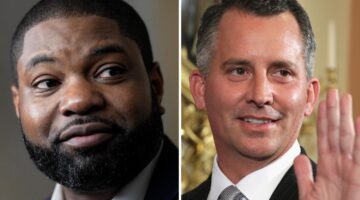






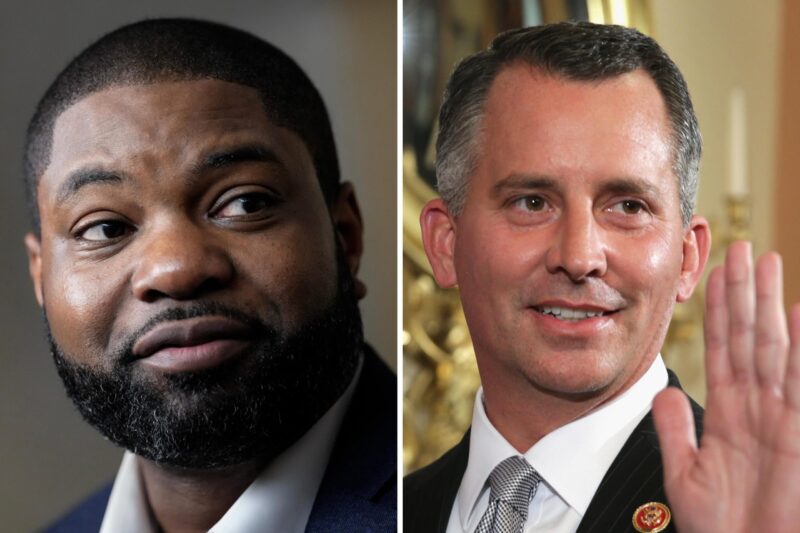
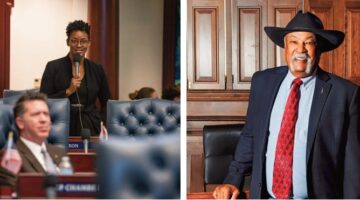
Florida gubernatorial candidates Republican U.S. Rep. Byron Donalds and Democrat and former congressman David Jolly (Photo courtesy megicula.info)
By David L. Snelling
South Florida Times
MIAMI – In less than a month, Florida voters will choose the next governor to replace GOP leader Ron DeSantis who is term-limited this year and endorsed the party’s nominee.
The stakes are high for the November 3 midterm elections, as Republican U.S. Rep. Byron Donalds and Democratic rival David Jolly, a former Congressman, are vying for the governor’s mansion.
The latest polls have mixed results as both candidates are hitting the campaign trail hard in the final stretch before voters decide their fate.
According to a poll conducted by Mason-Dixon Polling and Strategy, Donalds holds a 7-point lead over Democrat David Jolly in the race for Florida governor.
The survey conducted Sept. 28 through Oct. 1, among 625 likely voters, found Donalds at 48 percent, Jolly at 41 percent, another candidate at 1 percent, and 10 percent as undecided.
The margin of error is ±4 percentage points.
Men favor Donalds at 55 percent to 33 percent, while women back Jolly 49 percent to 41 percent.
White voters support Donalds with 59 percent to Jolly’s 30 percent; Black voters support Jolly 76 percent to 10 percent; and Hispanic voters narrowly prefer Donalds at 48 percent to 43 percent.
By party, Donalds takes 87 percent of Republicans and Jolly takes 85 percent of Democrats.
Independents favor Jolly 47 percent to 28 percent, with 24 percent undecided.
Regionally, Donalds leads in North Florida (60 percent-33 percent), Central Florida (55 percent-33 percent), and Southwest Florida (57 percent-33 percent).
Jolly leads in Tampa Bay (48-42 percent) and Southeast Florida (52 percent-36 percent).
Younger voters (18-34 and 35-49) lean narrowly toward Jolly, while older voters (50-64 and 65+) favor Donalds more decisively.
According to a Change Research Poll, both candidates are tied at 47 percent.
Donalds, who was also endorsed by President Donald Trump, is seeking to become the first Black governor of Florida while Jolly wants to be the first Democrat governor elected in over 32 years.
Jolly is focusing on changing the political landscape in Florida, criticizing DeSantis and other GOP leaders for failing to address significant issues gripping Florida including affordable homes, property insurance, high food and gas prices and adequate healthcare.
“People have felt the pent-up democracy that’s about to get exercised,” Jolly said during one of his political rallies, flanked by his running mate Gwen Graham. “For too long, Floridians have been told if we just stay divided and hate each other longer, somehow our lives will get better. This election, voters are saying “not anymore.” Florida’s ready for change.”
AI and data centers are among the issues at the forefront of the race.
Despite a boon to the economy, some Floridians including environmental groups oppose such facilities due to potential impact including higher utility bills and noise and water pollution.
Jolly said Republicans are trying to ram AI and data centers down the throats of Floridians who don’t want them.
He said he plans to slow down the effort.
“As Floridians rightfully worry about the impact of AI and data centers, Byron Donalds is telling them they’re wrong,” Jolly said. “My opponent takes millions from the developers who want to build data centers in your backyard. You have my word: Florida’s not for sale. As governor, I’ll sign a moratorium on day one.”
During an October 12, 2026 town hall meeting at FAMU in Tallahassee, Jolly outlined his political platform with the focus also on immigration enforcement, Diversity, Equity and Inclusion (DEI), and education investment.
Jolly said he plans to end the requirement for local law enforcement to assist ICE in arresting and detaining illegal immigrants which he calls racial profiling and unconstitutional.
He also said he plans to reinstate DEI, which Trump and GOP governors scaled back the framework to promote diversity and people underrepresented in colleges and workplaces.
According to a survey, Trump’s move to do away with most DEI requirements has created hardship among Blacks and other minorities in the job markets and college education as well as government positions.
On higher education investment, Jolly criticized the state for withholding $2 billion in funding due to FAMU and said the HBCU should be a priority, with a reshaped Board of Governors and a push toward flagship status.
Students pressed Jolly about his shift from Republican to Independent to Democrat.
He said the problem is not his past party membership but “people who know better today who remain in the Republican Party.”
He described changes on “issues like reproductive rights and gun policy as part of personal growth over time.”
During his recent 22- county campaign swing, Donalds brought his political platform to Antioch Missionary Baptist Church in Miami Gardens, where he was invited to speak to the congregation.
But it was contentious from the start.
According to social media, a woman stormed out of the church after the pastor endorsed Donalds and after the gubernatorial candidate referred to the Gulf of Mexico as the Gulf of America.
Pastor Arthur Jackson III told the congregation that he had invited candidates from both parties, but only Donalds had agreed to appear.
Nevertheless, Donalds’ focus is on affordability, healthcare reform, economic growth, education, law and order, infrastructure, environmental protection, and government transparency, with a strong emphasis on Florida-specific solutions and targeted tax relief for seniors and working families.
“From lowering costs to keeping our communities safe, I’m focused on what matters to you and your family,” he said. “Let’s keep working. The Florida Dream is worth fighting for.”
For housing and affordability, Donalds emphasizes lowering costs for working families and seniors, including streamlining local and state permitting to increase affordable housing supply.
He supports tax relief for seniors and working families and has proposed expanding the homestead exemption (to $150,000 in 2027 and $250,000 in 2028) while exploring full property tax elimination or targeted relief.
For healthcare, Donalds is advocating fr transparency in healthcare costs and reducing red tape so doctors can focus on patients.
For the economy and business, Donalds said he promotes reducing bureaucratic delays for business formation, opposing costly regulations, and fostering a business-friendly environment.
“It’s time to defend the Florida dream and build on the progress we’ve made,” he said.
Unlike Jolly, Donalds backs Florida’s mandate for local law enforcement to comply with ICE’s program and also supports border security, ending “taxpayer handouts” to illegal immigration.”
Donalds’ visit was part of a broader effort to reach Black voters whether they are Republicans, Democrats or Independents.
Donalds said his campaign is more appealing to Blacks since he’s trying to make history as the first African American governor of Florida.
“I think there’s a lot of Black voters who are looking at my campaign because they’re just trying to figure out who’s going to be the best person to lead Florida into the future,” Donalds told CBS.
He added that Black voters are “starting to not be as monolithically tied to the Democrat Party.”
Despite Trump’s low approval rating as Americans are reeling from high gas and oil prices and food costs, Donalds said Republicans are poised to run away with the midterm elections.
Donalds leads Jolly in fundraising, amassing a $90 million war chest, while his Democratic opponent has over $2.8 million in the bank, according to campaign finance reports.

No Comment