









By David L. Snelling
MIAMI – Florida residents are set to vote on property tax reform on the November 3, 2026 ballot, local governments are bracing for billions of dollars in loss revenue.
Tax revenue funds critical services like police, fire rescue, library and children services and infrastructure projects, as property taxes constitute about 45 percent of local governments’ operating budgets.
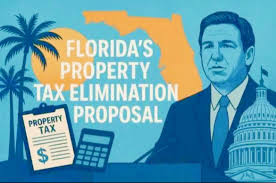
The property tax reform proposed by Florida Republican Gov. Ron DeSantis would give homeowners a $150,000 homestead exemption for 2027 and $250, 000 for 2028 if the ballot can reach the 60 percent voter threshold.
It would wipe out property taxes for about 60 percent of homeowners, but under the measure passed by Florida lawmakers during a special session in Tallahassee, property taxes for schools, police services and supervisors of elections and clerks of court are shielded.
The proposal is part of a broader push by DeSantis to eliminate property taxes altogether.
If local governments’ are struggling to balance their budgets, DeSantis said state funding would be available but he urged officials to make the necessary cuts.
Also in a bold recommendation, DeSantis, who’s term is limited this year, said local governments should start taxing the rich more to cover any revenue losses.
“Property taxes are the worst kind of taxes,” he said during a press conference before the start of the special session. “Taxing people who own their own homes to pay for services is the worst.”
DeSantis’ proposal was tweaked by both parties before the final vote.
The amendment needed 60 percent approval from members in the House and Senate.
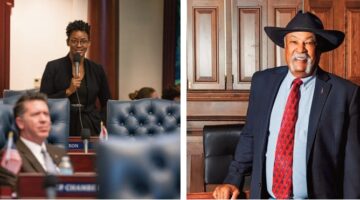
The House approved it with a 75-26 vote, where Republican Reps. Nathan Boyles and Patt Maney voted no and Democratic Rep. Dotie Joseph from North Miami voted in favor.
The Senate approved the amendment with a 30-9 vote, where Democratic Sens. Barbara Sharief (Broward County) and Darryl Rouson voted in favor of it alongside Republicans.
Local governments are pushing back on the proposal to eliminate property taxes for homeowners, as it might leave cities and counties without funding to provide adequate services.
Miami Dade, Broward and Palm Beach counties would be forced to make critical budget cuts and delay much needed infrastructure projects if voters approve the Constitutional amendment.
Miami-Dade Mayor Daniella Levine Cava said eliminating property taxes would have cost the county roughly $3.27 billion in revenue, which is about 19 percent of all revenue generated.
Broward County is looking at an estimated $1.6 billion revenue loss and $1 billion for Palm Beach County under Florida’s tax cut proposal.
Levine Cava said it would be a catastrophe for the county if voters approve to roll back property taxes.
“To eliminate or phase out this revenue stream, without a viable, guaranteed and locally-controlled replacement, would force choices no resident should have to face: closing fire stations, reducing police patrols, shuttering park facilities and cutting school programs that serve hundreds of thousands of children,” she said in a letter to the Miami Herald. “Here is what proponents of this plan are not telling you: eliminating property taxes does not eliminate the cost of government. It shifts how – and from whom – that cost is collected.
Levine Cava said renters and businesses may suffer the consequences.
“Many renters and business owners could end up paying more despite receiving no direct benefit from a homestead exemption, as higher costs are often passed along through rent increases, fees and higher prices,” she said.
In nearby Parkland, where it is estimated a loss of $27 million annually if ad valorem taxes were eliminated, the city has posted an information “tax talk” webpage.
“Eliminating local property taxes will not eliminate costs, it just shifts them,” Parkland government tells the residents. “It means higher sales taxes, new fees, or cuts to local services. And it re-routes decision-making from local communities to Tallahassee.”
Children and families non-profit organizations might also take a huge hit, forced to cut essential services including after school care, sexual abuse treatment and special needs care.
The organizations rely mostly on property taxes to fund services and the safety net for children and families is in peril.
“The impact on some of these non-profits would not be ‘Oh, my God, we lost some dollars and this program goes away.’ It could actually put a lot of these nonprofit organizations out of business,” said Cindy Arenberg Seltazer, President and CEO of Children’s Services Council of Broward County.
Some homeowners are split over the property taxes reform ballot.
Many Floridians, especially those with homestead properties, have welcomed the proposed increase in the homestead exemption, according to www.propertytaxesexemption.com.
Supporters argue the plan relieves them of a major cost, especially given that local property tax revenue has nearly doubled in the past seven years and is projected to reach $83 billion by 2032
However, other homeowners, particularly renters, first-time buyers, and lower-income families, are worried that the reform will drive up home prices, according to Realtor.com.



No Comment