








Black people have been fighting for centuries to gain agency and recognition as full citizens in these United States.
Through a variety of wide ranging expressions, including spoken and written words, song lyrics, dance movements, creating jazz and the blues, painting, photography, mass movements, elected representation, we have demanded to be seen, heard and fully accepted as American.
I recently had the privilege of experiencing one of the most celebrated contemporary artists who is offering us her version of being Black in America: Amy Sherald. widely critiqued and criticized but now is more commonly accepted as Sherald’s signature for painting Black people.
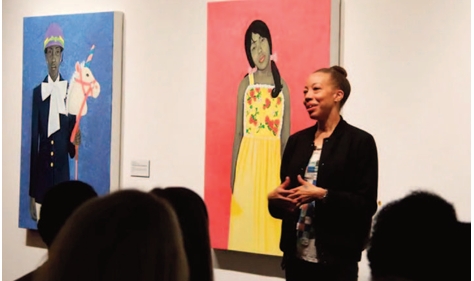
I went to see Sheralds’s exhibition: “American Sublime”, in its last two weeks at the High Museum, Atlanta, Georgia; an exciting, impactful and provocative display of American art by a brilliant young Black woman.
Only in her early 50’s, Sherald has many more productive years ahead of her.
The exhibition is considered “mid-career”. I was especially struck by Sherald’s highly politicized statements in most of her portraiture; the most famous being her commissioned portrait of First Lady Michelle Obama.
In it, her use of a gray skin tone was initially widely critiqued and criticized but now is more commonly accepted as Sherald’s signature for painting Black people.
The exhibit was recently challenged by some minions of the Trump administration for her rendering of the statue of liberty as a Black transgendered woman, entitled “Trans Forming Lib erty” (2024).
Sherald was asked in 2025 by the Smithsonian’s National Portrait Gallery to eliminate the portrait from her exhibit.
In response, she pulled the show stating that she could “not consent to a culture of censorship”.
Subsequently, the exhibition opened at the Baltimore Museum of Art; then Atlanta, and it goes next to the Peabody Essex Museum, Salem, Massachusetts through January 2027.
Kudos to the High Museum for including “Trans Forming Liberty” and several other ‘controversial’ paintings in her retrospective; many of which reinterpret the Black experience in America; people engaged in every day enterprises from riding tractors, rodeo attendants, children playing on slides, women in bathing suits or in church hats.
One portrait caught more of my attention than the others.
Entitled “American Grit”, the painting is of a Black man seated on a stool in the corner of a boxing ring.
The ropes around the ring are alternately colored red, white and blue.
The fighter’s body is muscular; his arms appear extra-long and hang down to the floor of the ring where they rest, weighted down in futility.
The boxer’s hands are encased in oversized stark white boxing gloves, still pristine; obviously not yet used to land any blows, and he looks defeated while staring at the viewer.
Of note, the boxer has no legs! It is that part which renders the boxer’s whole body and his entire countenance out of balance, not having a chance at a “fair” fight.
Yet, he is there- dressed and ready to enter the fray- if only given a fighting chance.
The image was disturbing; it unsettled me.
I engaged in conversation with one of the security guards, a Black male, who gave me his interpretation: Black men never had a chance to win in America; their legs having been cut off after entering the ring; even in a ‘sanctioned’ fight.
I agreed.
In that painting, Sherald makes another provocative and pointed observation about the status of Black men- and Blacks in general, in the USA: if we are given a level playing field, given our legs, we can win!
It is a bold, intentional, colorful, and awful statement all at the same time, as is much of her work where she selects her subjects who she first photographs and then paints in order to present their authentic selves in clothing, accessories, postures and direct gazes back at the viewers.
Sometimes pretty, often whimsical, but nearly always more than some colorful picture; the commentary embedded in Sherald’s art requires one to take a longer look past the borders of the canvases.
As she explained in her portrait of Michelle Obama, the 2018 painting was designed to capture Obama’s humanity rather than a standard public persona. I think Sherald clearly understands the humanity of Black folk and dares to put us squarely into the public arenas of American life- where we belong.
If you cannot go in person to see this exhibit, Sherald’s expansive work can be seen online.
Check them out.
I hope you too will be moved to “see” yourself in a new perspective- as fully Black and fully American.

No Comment