









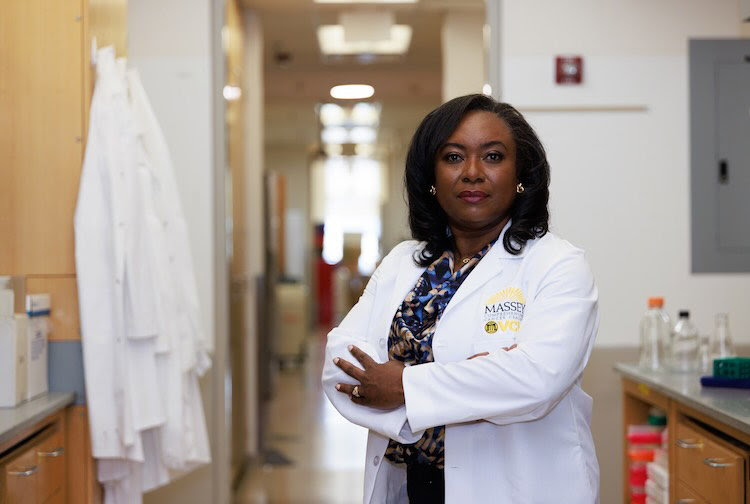
Dr. Monica Baskin named first Black woman director of VCU Cancer Center (Photo courtesy of VCU Massey Comprehensive Cancer Center)
By David L. Snelling
Dr. Monica L. Baskin was named the new director of Virginia Commonwealth University’s Massey Comprehensive Cancer Center, making her the first Black woman to lead a nationally renowned cancer institute.
She is the fifth director of the VCU Massey Comprehensive Cancer Center in its 51-year history.
Baskin is a psychologist and behavioral scientist, whose research focuses on cancer prevention, behavioral medicine, and health equity.
She is also the Associate Dean for Cancer Innovation and professor of hematology, oncology and palliative care at the Virginia Commonwealth University School of Medicine.
In addition, Baskin has a secondary appointment as professor of social and behavioral sciences in the VCU School of Public Health.
She is a former president of the Society of Behavioral Medicine and recently chaired the cancer incidence panel for the World Cancer Research Fund International’s Global Cancer Update Program.
As the director of the Virginia Commonwealth University’s Massey Comprehensive Cancer Center, she will oversee the work of about 250 scientists and clinical investigators.
Her role is both scientific and community-focused, with several key responsibilities including leading cancer research and innovation, advancing health equity, community engagement and outreach, developing strategic leadership and in charge of funding, and personal advocacy and patient care.
“It is an honor to be named as the next director at VCU Massey Comprehensive Cancer Center,” Baskin said in a statement. “Massey is an exemplar, locally and nationally, on what truly matters for a cancer center, and together we will continue to be defined by cutting-edge science, compassionate care and collaboration with our community to ensure everyone has access to lifesaving cancer prevention and treatment.”
Dr. Michael Rao, president of Virginia Commonwealth University, said Dr. Baskin’s robust portfolio of research publications combined with her passion and drive for community-focused cancer research has positioned her well to become the next director of Massey Comprehensive Cancer Center.
“Throughout her career, especially in the past year as Massey’s deputy director, she has shown dedication to Massey being on the cutting edge of cancer research. She is a champion of the community-to-bench model, and will work hard so the cancer center has a direct impact on those in its catchment area.”
Cancer hit close to home for Baskin.
As a teenager, her father died from his second cancer diagnosis which advanced stage of the disease.
The tragic loss influenced her interest in understanding cancer, health disparities, and the barriers that affect access to prevention, early detection, and care, particularly among communities that have historically experienced worse outcomes.
Baskin studied psychology and sociology at Emory University before completing graduate training at Georgia State University, where she earned a master’s degree in community counseling and a doctoral degree in counseling psychology.
Her interdisciplinary training in psychology, counseling, and public health shaped her later research in behavioral medicine, cancer prevention, and community-engaged research.
After completing her doctoral training, Baskin returned to Emory University, where she completed a pediatric psychology fellowship prior to obtaining her license as a professional psychologist.
Baskin’s research focuses on behavioral medicine, cancer prevention and early detection, obesity, and community-engaged approaches to improving health outcomes and eliminating health disparities.
Her work examines how social, behavioral, and environmental factors influence health outcomes and how community-based interventions can improve health outcomes for all.
In the early stages of her career, Baskin investigated behavioral and psychological factors related to chronic disease prevention, including obesity and health behaviors.
Her research contributed to understanding obesity prevalence and the role of behavioral interventions in improving health outcomes among diverse populations.
In 2005, Baskin co-authored a review examining the prevalence of obesity in the United States and factors contributing to obesity trends.
Her later work expanded into community-based health promotion, including research on faith-based interventions as a strategy for addressing health disparities.
In 2007, she co-authored “Church-Based Health Promotion Interventions: Evidence and Lessons Learned,” which examined the effectiveness of partnerships between researchers and faith communities to promote health behaviors.
In 2013 Baskin coordinated the report “PLACE MATTERS for Health in Jefferson County, Alabama: The Status of Health Equity on the 50th Anniversary of the Civil Rights Movement in Birmingham, Alabama.”
The report was released fifty years after the protests in Birmingham marking when the Jim Crow laws were overruled.
The report collected information of life expectancy, infant mortality and access to healthy food in various areas across the county, and studied how they depended on the demographics of the communities including ethnicity and socioeconomic status.
She identified that Black mothers in Jefferson County were 2.5 times more likely to die during childbirth as white mothers, and that Black households in Jefferson County had annual incomes $22,000 below the federal poverty guideline.
The report made a series of recommendations, including funding early childhood education programmes, implementing financial programmes to provide healthy food in poor neighborhoods and expanding Medicaid.
In 2015 Baskin was awarded an National Cancer Institute grant to develop strategies to prevent obesity in African American women.
Her research has shown the close relationships between cancer and obesity, and identified that African American women are most at risk.

No Comment