







By EDMOND W. DAVIS Celebrity Journalist | Social Historian | Documentary Host | Professor Little Rock, Arkansas
For generations, African Americans have commemorated Juneteenth as a celebration of freedom, resilience, and perseverance. We gather at festivals, family reunions, church events, and community celebrations to honor the long journey from bondage to liberation.
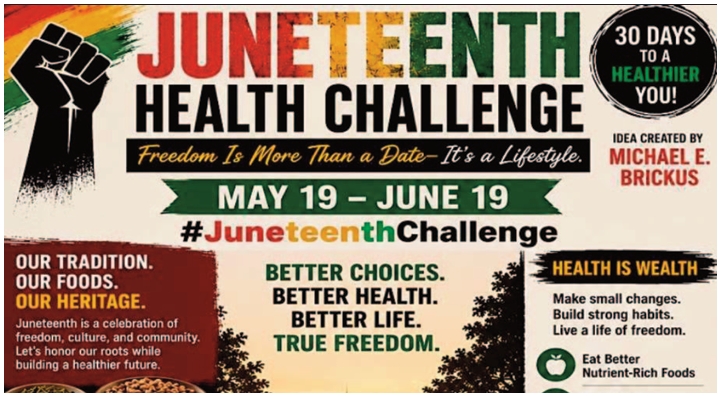
Yet in 2026, a new movement is asking an important question: What good is freedom if we are not healthy enough to enjoy it? That question is at the heart of the growing Juneteenth Health Challenge, a grassroots wellness initiative launched by Coatesville, Pennsylvania
(a town west of Philadelphia) na tive Michael E. Brickus. An entrepreneur (Brickus Transport, The Brickus Network & Travel Agency), podcaster/YouTuber, social media influencer/public figure, fitness advocate, philanthropist, and community leader, Brickus challenged individuals from May 19 through June 19, 2026, to become intentional about their health through better nutrition, accountability, and daily physical activity.
What began as a simple challenge has quickly evolved into a movement stretching across Pennsylvania, Delaware, Texas, Arkansas, and beyond.
The premise is straightforward: commit to healthier living for 30 days (and beyond), encourage one another, exercise at least 30 minutes daily, and become more conscious of what is placed on our plates and poured into our cups. family issues.
They are economic is sues. Every funeral that comes too early.
Every grandparent lost prematurely. Every parent is suffering from a pre ventable illness.
Every child growing up without healthy examples of well ness carries consequences that ripple through generations.
In 1 Corinthians 6:19-20, Scripture asks: “Do you not know that your bodies are temples of the Holy Spirit, who is in you, whom you have received from God?
You are not your own; you were bought at a price.
Therefore honor God with your bodies.” Likewise, 3 John 1:2 states: “Beloved, I wish above all things that thou mayest prosper and be in health, even as thy soul prospereth.”
Those verses challenge us to view health not merely as a personal preference but as a responsibility.
Far too often, conversations within our com about fathers living long enough to see grandchildren graduate.
It is about mothers avoiding preventable diseases.
It is about reducing health care costs. It is about improving the quality of life.
Most importantly, it is about understanding that wellness is not an event. It is a lifestyle.
The challenge officially concludes on Juneteenth, but the mission should not.
The real victory comes when the habits developed during those 30 days become part of everyday life.
Michael E. Brickus has provided a blueprint. Now it is up to the rest of us to continue building upon.
In many ways, Brickus is asking par ticipants to redefine freedom.
Historically, Juneteenth symbolizes the delayed arrival of freedom to enslaved African Americans in Texas on June 19, 1865.
But nearly 161 years later, many African Americans remain trapped by another form of bondage— preventable chronic disease.
The statistics are sobering.
According to research published in the peer-reviewed journal Circulation and the National Library of Medicine, African Americans experience significantly higher rates of hypertension than any other racial or ethnic group in the United States, contributing to increased risks of heart disease, stroke, and premature death.
Similarly, studies published in The Journal of the American Medical Association (JAMA) have documented disproportionately high rates of Type 2 diabetes among African Americans, with lifestyle factors such as nutrition, physical inactivity, and obesity serving as major contributors. These are not simply medical issues.
They are community issues. They are Juneteenth Health Challenge, a grassroots wellness initiative launched by Coatesville, Pennsylvania (a town west of Philadelphia) native Michael E. Brickus. Michael Brickus, his wife, and family recognized that reality and chose actions over excuses.
One of the most refreshing aspects of the Juneteenth Health Challenge is that it is not a one-size-fits-all program.
Participants are encouraged to adapt the challenge to their personal circumstances, physical abilities, age, and health conditions.
The goal is not perfection.
The goal is progress. For some, the challenge may involve eliminating sugary beverages.
For others, it may mean walking 30 minutes daily. Some may focus on weight loss.
Others may focus on blood pressure control, diabetes management, mental wellness, or reducing alcohol consumption.
The common denominator is consistency. The Bible repeatedly reminds believers that stewardship extends beyond finances and possessions—it includes the body itself.
In 1 Corinthians 6:19-20, Scripture asks: “Do you not know that your bodies are temples of the Holy Spirit, who is in you, whom you have received from God? You are not your own; you were bought at a price. Therefore honor God with your bodies.” Likewise, 3 John 1:2 states:
“Beloved, I wish above all things that thou mayest prosper and be in health, even as thy soul prospereth.” Those verses challenge us to view health not merely as a personal preference but as a responsibility.
Far too often, conversations within our communities focus exclusively on spiritual growth, educational advancement, financial literacy, or political empowerment while overlooking physical wellness. Yet all of those goals become more difficult when poor health limits our ability to enjoy life, care for loved ones, or pursue our purpose.
As a social historian, I often remind audiences that many of the health disparities affecting African Americans today are rooted in historical realities.
Food deserts, limited healthcare access, economic inequality, and environmental factors have all played roles in shaping health outcomes.
However, history also teaches another lesson.
Communities can change their future when they collectively decide to do so.
That is why the Juneteenth Health Challenge matters. This is not merely about losing a few pounds before summer. It is not about six-pack abs or social media photos.
It is about creating a culture shift.
It’s about fathers living long enough to see grandchildren graduate.
It is about mothers avoiding preventable diseases.
It is about reducing health care costs. It is about improving the quality of life.
Most importantly, it is about understanding that wellness is not an event. It is a lifestyle.
The challenge officially concludes on Juneteenth, but the mission should not.
The real victory comes when the habits developed during those 30 days become part of everyday life. Michael E. Brickus has provided a blueprint.
Now it is up to the rest of us to continue building upon it.
As we celebrate freedom this Juneteenth season, perhaps the greatest act of self-determination we can embrace is choosing better health.
After all, you only get one body.
Treat it right, and it will treat you right.
Freedom is not just something we commemorate. It is something we live.
Freedom is for everyone, as is good health, regardless of ancestry, color, nationality, and ethnicity—so is Juneteenth.
And healthy living may be one of the most powerful forms of freedom we can ever achieve.
To Mr. and Mrs. Brickus, Black America thanks you; the United States braces you, and the world appreciates you.
Take the Juneteenth Health Challenge near you. #JuneteenthHealthChallenge #June teenthChallenge.
Edmond W. Davis is a social historian, journalist, and professor. He is the founder of the National HBCU Black Wall Street Career Fest.


No Comment