

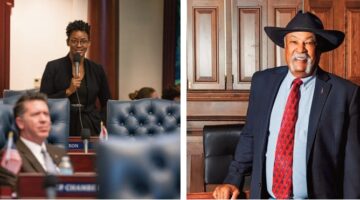
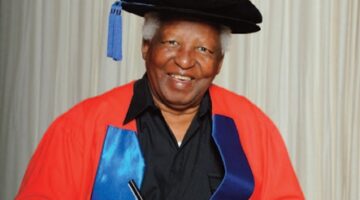



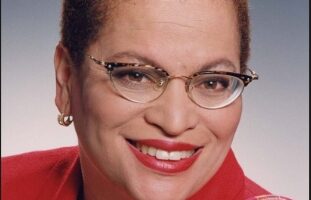

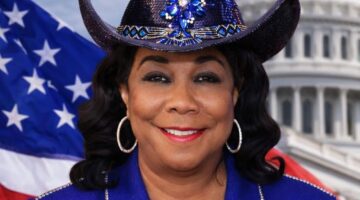

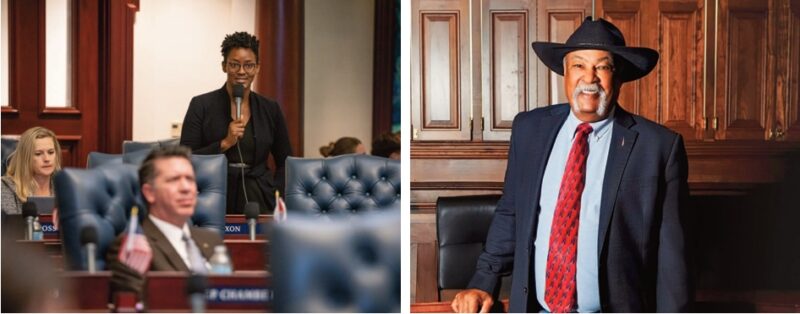
U.S. Senate candidates Angie Nixon and James Byrd (PHOTOS COURTESY OF FLHOUSE.GOV, BALLOTPEDIA.COM AND FACEBOOK).
By David L. Snelling
South Florida Times
MIAMI – As former Florida state Representative Angie Nixon, a Democrat, is seeking to become the first Black U.S. senator in Florida in her bid to unseat incumbent Ashley Moody, James Byrd is vying for the same distinction 1,712 miles away in Wyoming.
After winning the Democratic primary in August 2026, Byrd is one victory away from becoming the first Black U.S. senator in Wyoming’s 136-year history.
The 72-year-old Wyoming native trounced Billy Benaide with 78 percent of the vote to secure the Democratic nomination and faces GOP candidate U.S. Rep. Harriet Haeman, who’s endorsed by President Donald Trump.
The winner will replace Republican Senator Cynthia Lummis who decided not to seek another term in political office.
Nixon and Bryd are among the few U.S. Senate Black candidates left running in the November 3, 2026 election, when 35 seats are up for grabs.
The Democratic Party is throwing all of its support behind the candidates seeking to flip seats in the U.S. Senate and Congress.
For Byrd, Wyoming has not elected a Democrat to the U.S. Senate since 1970.
Byrd, who served ten years in the Wyoming House of Representatives (2009–2019) representing Cheyenne’s District 44, is facing an uphill battle to achieve history.
Wyoming’s Black population is one of the lowest in the U.S. with 1.66 percent or roughly 4,895 residents, compared to the national average of 12.6 percent, according to World Population Review.
Whites, Asians and Native Americans constitute 81 percent of the state’s total population of 582,397, one of the largest racial disparities in the country.
The Black population in Wyoming is concentrated in a few urban areas, while many smaller towns have little to no recorded Black residents, according to Neilsberg.com.
Larger cities such as Cheyenne, Casper, and Laramie tend to have the highest numbers, though the overall population remains small relative to the state’s total.
The Black population in Wyoming has grown modestly since the 2020 Census, with an estimated increase of 3.4 percent over recent years.
Despite the growth, the share of Black residents remains under 2 percent of the state’s total population.
As of September 2026, Wyoming has 339, 655 total registered voters: 255,199 Republicans (75.1 percent) and 41,659 Democrats (12.3 percent), 10.8 percent Independents and 1.8 percent with other party affiliations, according to Independent Voter Project.
Despite the odds, Byrd believes he can win the race, as most Americans are unhappy over the way Trump is running the country including the war with Iran and rising oil and gas prices.
Some GOP candidates nationwide are gradually distancing themselves from Trump after he received a low approval rating in the final stretch of the November election.
“I bring a deep understanding of the challenges facing our families,” he said. “Let’s build on the core values of transparency, economic resilience, and the unwavering protection of Wyoming’s unique heritage.”
Recognized for his leadership, Byrd’s legislative peers elected him Minority Whip (2013–2015) and Minority Caucus Leader (2015–2017).
Building on his statehouse tenure, he ran as the Democratic nominee for Wyoming Secretary of State in 2018.
Before entering political office, Byrd has built a diverse professional career spanning the energy and technology sectors.
Byrd, a vocal GOP critic, said the Trump administration has failed to make healthcare more affordable, which is the cornerstone of his campaign.
“Federal lawmakers should protect and stabilize our rural healthcare system by safeguarding support programs and critical access designations,” he said. “Ensuring small, rural facilities have flexible federal funding prevents closures that create healthcare deserts on Main Street.”
Wyoming’s poverty rate is 10.1 percent with the median household income of $74,81.
The median gross rent in Wyoming is $968 per month.
Byrd said the average monthly health insurance premium for a 40‑year‑old in Wyoming in 2025 was $752, up $108 from the prior year.
For a 60‑year‑old earning about $63,000, average monthly ACA marketplace premiums are projected to jump 421 percent, the largest increase in the U.S. — from around $600 to $3,000 per month.
According to BetterWyoming.org, Wyoming ranks 36th nationally for affordability and near the bottom for cost accessibility, with one of the highest uninsured adult rates (16 percent) and one of the highest child uninsured rates (10 percent).
Surveys show residents cite high deductibles ($1,500–$20,000) and rising prices as top concerns.
“Congress can lower out-of-pocket expenses by pushing for transparent medical pricing, capping soaring prescription drug costs, and protecting consumer-friendly provisions in federal health insurance markets to relieve the strain on family budgets,” Byrd said. “We must expand local care options by increasing federal investments in broadband infrastructure and making telehealth reimbursements permanent, allowing rural residents to access specialists without driving hundreds of miles.”
Byrd said Wyoming faces a critical turning point: balancing its legacy as an energy powerhouse with the urgent need for economic diversification, all while protecting its natural heritage and rural communities.
He said volatile fossil fuel markets threaten state revenues, while next-generation energy innovations, like advanced nuclear and minerals, and a booming outdoor recreation economy offer massive opportunities.
“As a federal lawmaker, I would champion federal permitting reform and scale up initiatives modeled after the state’s newly established Wyoming Energy Dominance Fund to incentivize cutting-edge technology, such as the TerraPower Natrium nuclear project,” he said. “This protects traditional energy workers while drawing tech sectors like data centers to the state. Because over 90 percent of Wyomingites rely on public lands for their livelihood or recreation, I would fight to keep federal lands public and under multi-use management with heavy local input.”
Nixon, who recently pleaded no contest to a charge of staging a sit-in in the office of Florida Republican Gov. Ron DeSantis over the GOP-controlled Legislation’s Congressional redistricting vote, is neck and neck with Moody in several of the polls.
She agreed to pay a $250 fine and do 15 hours of community service for the charges to be dismissed.
In the St. Pete Polls conducted by Florida Politics, the two candidates are tied with 45 percent.
In a poll conducted by Insider Advantage, Moody, former Florida Attorney General, leads Nixon 49-42.
On the campaign trail, Nixon criticized Moody for voting to end the ACA subsidies, as roughly 300,000 Floridians lost the help they needed to pay for health insurance.
“And premiums went up for everybody else on private plans, too,” Nixon said. “Medical debt is the number one cause of bankruptcy in this country. People are going broke trying to stay alive. That is where we are.”
Nixon said, if elected, she plans on sponsoring legislation to restore the subsidies, and push for Medicare for Floridians.
“Nobody should go bankrupt to go to the doctor,” she said.
Nixon initially divided the Democratic Party with her socialism and using a bullhorn to denounce the redistricting vote, but now is rallying around her campaign as she has a good chance of flipping the seat.
A member of the Working Families Party and the Democratic Socialists of America, she is the Democratic nominee after upsetting Alex Vindman, a retired United States Army lieutenant colonel who served as the Director of European Affairs for the National Security Council.
Nixon’s campaign focuses on a wide-range of issues impacting Floridians including affordability, universal health care, higher taxes on the wealthy and a minimum wage of $25 per hour.
Nixon is currently Director for the Florida Public Service Union’s (FPSU) Higher Education Campaign and was previously the Florida state field director for the Service Employees International Union (SEIU), of which FPSU is an affiliate.
Since 2022, she has also been the executive director of Florida For All, a coalition of six different organizations, including SEIU, that works to promote voter rights and enfranchisement.
Moody said Nixon is a member of the “I hate American DSA Party and decried its stance on defunding the police and abolishing prisons.
“This stuff is anti-American,” Moody said.
Nixon rejected Moody’s assertions.
Moody has declined to debate Nixon ahead of November’s election.
Nixon is also among a few Black women candidates running for the U.S. Senate and governor including Illinois Lt. Governor Juliana Stratton, Tennessee environmentalist Marquita Bradshaw and South Carolina activist Catherine Fleming Bruce, and Georgia gubernatorial candidate Keisha Lance Bottoms, a former mayor of Atlanta.
Bryd is facing one of Trump’s staunchest supporters.
Haeman, an attorney by trade, said she supports Trump’s policies including his illegal immigration crackdown operation that has deported roughly 900,000 people since his return to the White House, according to North American Community Hub statistics.
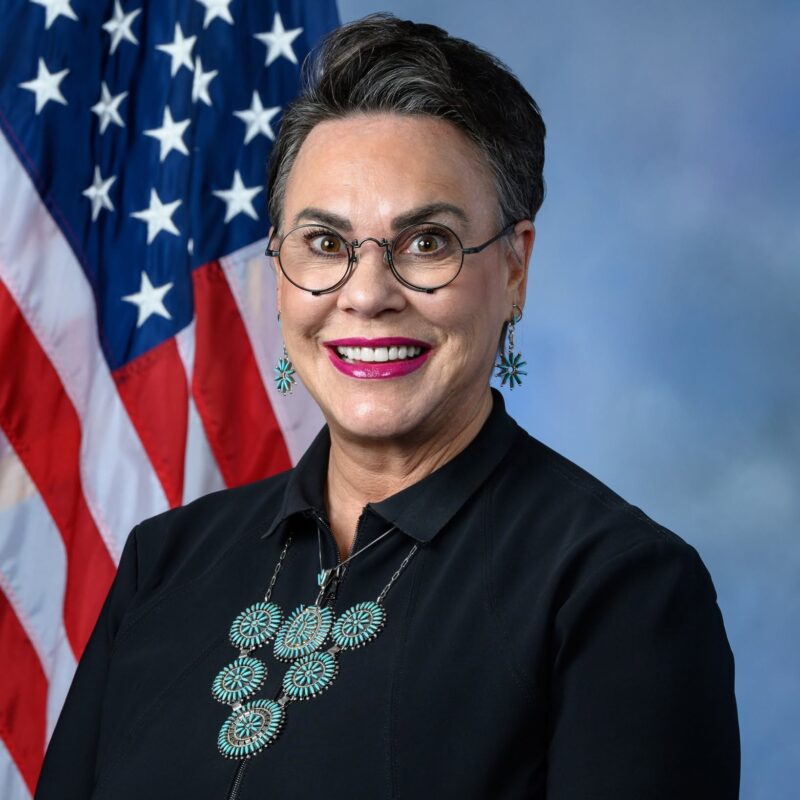
Haeman, 64, said the President Biden administration’s open border policy directly resulted in the deaths of Americans and wreaked havoc on almost every aspect of our lives.
“I have spoken with parents who lost children to fentanyl, whose daughters were murdered and raped by criminal illegal aliens, and whose schools are becoming less governable because of the influx of non-English-speaking students,” she said. ‘I am fighting to get untrained and illegal truck drivers off of our roads. A country without borders is no country at all.’
Heaman said a closed border is necessary for the safety and security of any nation.
“Those wishing to immigrate here should enter legally,” she said. “We welcome those who provide a net benefit to our country in terms of education, qualifications, and willingness to assimilate. This policy of selective immigration is in line with every other developed country. Congress must keep border security funded while the administration continues an aggressive campaign to deport the criminal illegal immigrants first.”
Heaman, also a Wyoming native, said she practiced as a water, natural resources and constitutional trial attorney for over 30 years, defending private property rights, fighting bureaucratic overreach and working on policy for a variety of clients.
She said she advocated for regulatory reform and adherence to our constitutional framework.
“I represented the State of Wyoming, farmers, ranchers, municipalities, counties, trade organizations, and small businesses, among others,” she said.
Heaman said when she was elected U.S. Rep. in 2022, she was able to secure more than $40 million in community project funding for local projects throughout Wyoming.
She also said she returned $16 million directly to Wyoming businesses and individuals through case work, including money being wrongfully withheld by the IRS, the Social Security Administration, the VA, and others.
“I have passed 41 legislative wins over my 3 ½ year tenure. I look forward to continuing my service if I am fortunate enough to be elected to the Senate,” she said.
Heanan said Wyoming’s biggest challenges are the bloated administrative state and preserving the state’s western way of life.
For opportunities, she said Wyoming’s energy and mineral resources provide an excellent opportunity to create jobs, improve our standard of living, fund local and state governments, and place residents squarely at the center of national energy policy.
“As government officials, our primary responsibility is to preserve and protect our constitutional rights,’ she said.



No Comment